GPS Tracker Offline Data Storage: What Happens When the Network Drops?
A vehicle travels through a rural area with weak cellular coverage. A livestock collar moves beyond the reach of a farm gateway. An asset tracker temporarily loses its connection to the tracking server.
In each situation, the tracking platform may stop receiving updates. However, a missing update does not necessarily mean that the device has stopped obtaining positions.
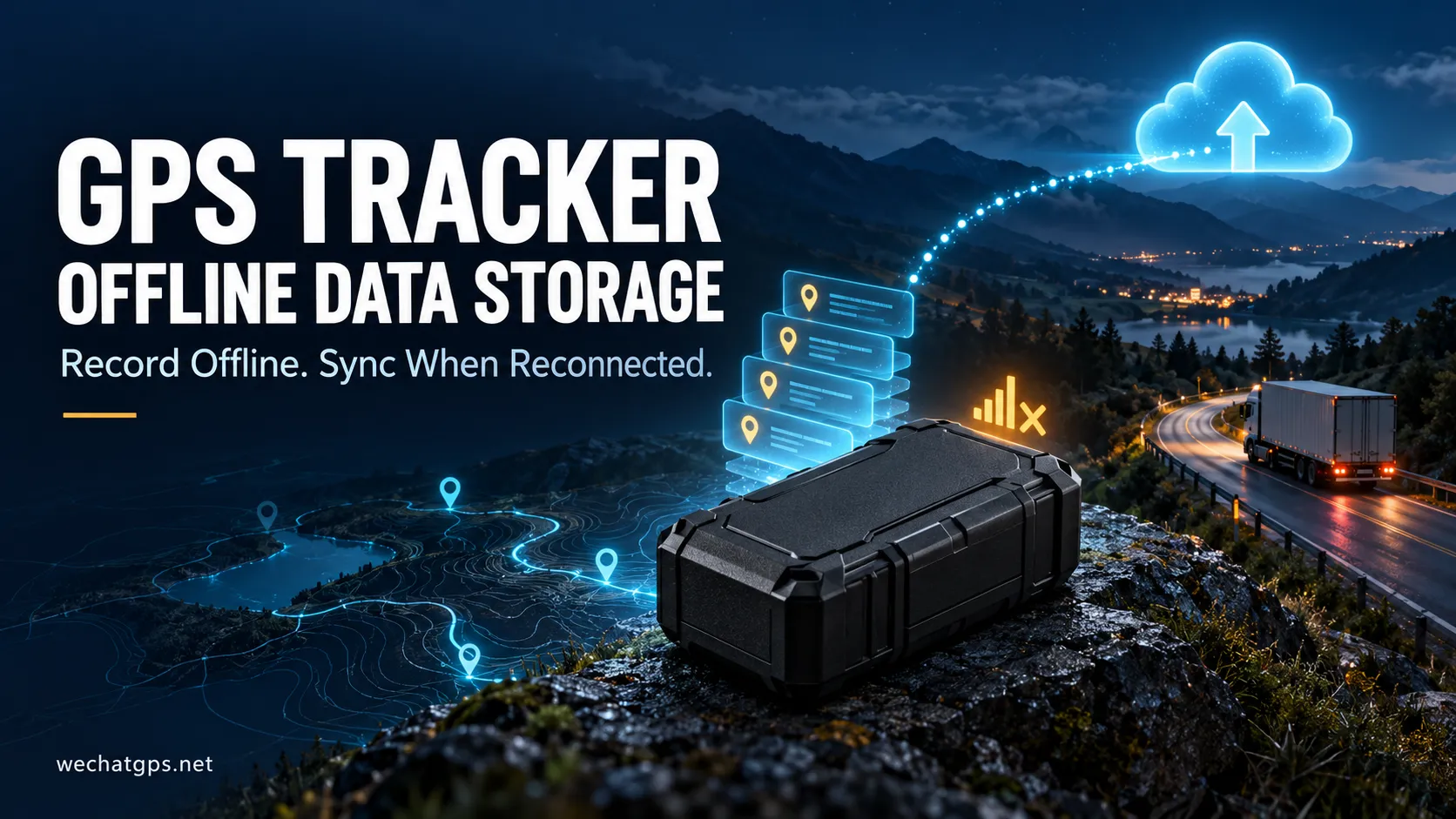
GPS tracker offline data storage allows a compatible device to retain records locally and transmit them later. Understanding this process helps buyers evaluate tracking reliability and helps project teams define more useful hardware, firmware, and platform requirements.
GPS Positioning and Data Uploading Are Different Processes
A tracking device performs two separate tasks: determining its location and delivering that information to a remote platform.
The GNSS receiver obtains positioning signals from satellites. A communication module then sends the resulting records through a supported network.
Losing a cellular connection does not automatically prevent the GNSS receiver from obtaining a position. If the device remains powered, has sufficient satellite visibility, and is configured to keep recording, it may continue collecting location data.
The reverse is also possible. A tracker may remain connected to a mobile network while failing to obtain a reliable satellite position inside a building or beneath substantial overhead cover.
These conditions should be distinguished in the platform:
- A communication outage means that fresh records are not reaching the server.
- A positioning failure means that the device cannot obtain a valid new satellite position.
- A power interruption may stop both positioning and communication.
Offline storage helps preserve records during a communication outage. It cannot recreate satellite positions that the device never obtained.
What Is GPS Tracker Offline Data Storage?
Offline data storage is the ability to save tracking records in the device when immediate delivery is unavailable.
A typical implementation follows this sequence:
- The tracker obtains a location or generates an event.
- Firmware assigns the record a timestamp and identifying information.
- The record is retained in local memory.
- The device attempts to upload stored records when communication becomes available.
- Successfully acknowledged records become eligible for removal under the device’s retention policy.
This process is often called store-and-forward tracking.
Its effectiveness depends on the complete implementation. Memory capacity alone does not establish whether records survive a restart, whether delivery is confirmed, or whether the platform handles delayed data correctly.
Which Records Should Be Stored?
The appropriate record structure depends on the application.
For basic route history, useful fields include:
- Device identifier.
- Original recording time.
- Latitude and longitude.
- Position validity.
- Speed and heading, where available.
- Record sequence number.
- Battery or external power status.
Projects with connected sensors may also need input states, temperature readings, or fuel sensor measurements.
Each sensor measurement should retain its acquisition time. A reading collected during an outage should not appear to have been measured at the moment it finally reaches the server.
Invalid positions should also be identified clearly. Repeatedly saving the last known coordinates as though they were new fixes can create misleading route and movement reports.
How Much Offline Storage Does a Project Need?
Storage requirements depend on the recording interval, record size, and longest outage the project needs to tolerate.
A practical starting point is:
Required storage = records per day × bytes per record × offline days
Consider an illustrative configuration:
| Design assumption | Example |
|---|---|
| Recording interval | Every 60 seconds |
| Records per day | 1,440 |
| Stored record size | 64 bytes |
| Required offline duration | 7 days |
| Raw record storage | 645,120 bytes, approximately 630 KiB |
This calculation covers raw records only. An actual design needs additional space for metadata, event records, storage management, and an operating margin.
The figures are an example, not a specification for a particular tracker.
Recording more frequently increases storage demand. Event-triggered recording may also generate additional records beyond the normal scheduled interval.
Buyers should therefore ask how many days of data a tracker can retain under their intended configuration, rather than comparing memory size in isolation.
What Happens When the Memory Becomes Full?
Storage is finite, so the device needs a defined overflow policy.
Possible approaches include overwriting the oldest records, stopping routine recording, or reserving capacity for selected events.
Each approach has consequences. Overwriting older records preserves recent history but may erase the beginning of a long trip. Stopping recording protects existing data but leaves a gap in newer activity.
A procurement specification should state:
- Which records are overwritten first.
- Whether important events receive reserved storage.
- Whether a storage-full condition is reported.
- Whether unsent records survive a restart.
- How users can identify gaps caused by overflow.
A claim such as “supports offline tracking” is incomplete without these details.
How Should Data Upload After Reconnection?
When communication returns, the tracker may have both new records and a backlog of historical records to transmit.
Uploading the oldest records first helps reconstruct history in order. Prioritizing current records helps operators see the latest status quickly.
A useful design can provide the current position promptly while transferring historical records in controlled batches. The appropriate behavior depends on the application and available network capacity.
For large deployments, reconnection deserves particular attention. If many devices reconnect after the same network outage, simultaneous uploads can place a substantial load on the server.
Recovery testing should therefore consider batch size, retry timing, live-update responsiveness, and the number of devices expected to reconnect together.
Why Original Timestamps Matter
A platform should distinguish between the time a record was created and the time it was received.
Suppose a tracker records a position at 10:15 but uploads it at 11:40 after coverage returns. The historical route should place that record at 10:15.
Treating the arrival time as the recording time can distort:
- Route playback.
- Stop-duration calculations.
- Working-time reports.
- Sensor-event comparisons.
- Geofence event history.
The platform should also prevent delayed historical records from replacing a newer position on the live map.
A practical data model retains both the original event time and the server receipt time.
Preventing Missing and Duplicate Records
Interrupted connections can make delivery status uncertain. For example, the server may accept a batch while the device fails to receive the acknowledgment.
If the tracker retries, the server may receive the same records again.
A robust design should use record identifiers, acknowledgment handling, and server-side duplicate detection. Record identification should remain unambiguous across device restarts and sequence-number rollover.
The device should not treat “transmission attempted” as equivalent to “records safely accepted.”
Likewise, the server should be able to accept a retry without adding duplicate route points or counting the same event twice.
Offline Storage Does Not Provide Live Alerts
A locally stored event cannot reach a remote operator until a communication path becomes available.
A compatible device may detect and retain an event during an outage, but the notification will be delayed. Some device-side actions may continue independently if they are implemented locally.
The platform should clearly distinguish a delayed event from a newly occurring event. For example, an alert received after reconnection should display when it actually happened.
If immediate remote notification is essential, offline storage alone does not meet that requirement. Communication coverage and any supported alternative communication paths need separate evaluation.
How to Test Offline Data Recovery
A useful acceptance test should verify the entire path from local recording to platform display.
Begin with a powered tracker, valid positioning, and normal communication. Then create a controlled communication interruption while allowing the device to continue recording.
Use a known route or a documented sequence of events so that recovered records can be compared with an expected result.
| Test | What to verify |
|---|---|
| Short communication outage | Records collected during the interruption appear after reconnection |
| Device restart while offline | Retained records survive if this is a product requirement |
| Nearly full storage | The documented overflow policy behaves as expected |
| Interrupted recovery upload | Retries do not create unexplained gaps or duplicates |
| Historical backlog with fresh updates | The live map continues to show the latest valid position |
| Delayed event delivery | Original event time remains visible |
| Multiple devices reconnecting | Recovery remains stable under the expected load |
Record the actual recovery time as well as the number of recovered records. A successful connection does not necessarily mean that the entire backlog has already uploaded.
Defining Offline Storage for a Custom GPS Tracker
For an OEM or custom development project, offline behavior should be specified before hardware and firmware decisions are finalized.
Useful requirements include the expected maximum outage duration, recording interval, required sensor fields, retention across power loss, overflow policy, and acceptable recovery time.
Platform requirements are equally important. The server must interpret timestamps correctly, handle retries, insert historical records into the proper sequence, and keep current status separate from older data.
When discussing a project with WeChat GPS, provide the application, operating region, reporting schedule, anticipated coverage gaps, and required event types. These details help establish whether the proposed device and platform configuration can deliver the required tracking history.
Frequently Asked Questions
Can a GPS tracker record locations without a mobile connection?
A compatible tracker can record positions locally without a mobile connection if it remains powered, can obtain positions, and has suitable firmware and available storage. Remote viewing requires a working communication path.
Will every GPS tracker upload missing history automatically?
No. Automatic recovery depends on the model, firmware configuration, communication protocol, and platform integration. It should be verified during sample testing.
Can offline storage recover a route through a tunnel?
It can preserve records that the device actually obtains. If satellite positioning fails inside the tunnel, ordinary offline storage cannot reconstruct the missing positions. Any estimated movement would require separate capabilities.
Does a larger memory guarantee a complete history?
No. Recording settings, power continuity, storage handling, position availability, and successful server delivery all affect the final result.
What should buyers request before ordering?
Request a documented offline recording capacity under the intended settings, the overflow policy, restart behavior, and a demonstration of interrupted-upload recovery. These provide more useful evidence than an offline-storage claim alone.
High-Quality GPS Recommendation
3、Shipping Container GPS Tracker
4、Electronic cargo seal tracking
6、Ear Tag with GPS and LoRaWAN