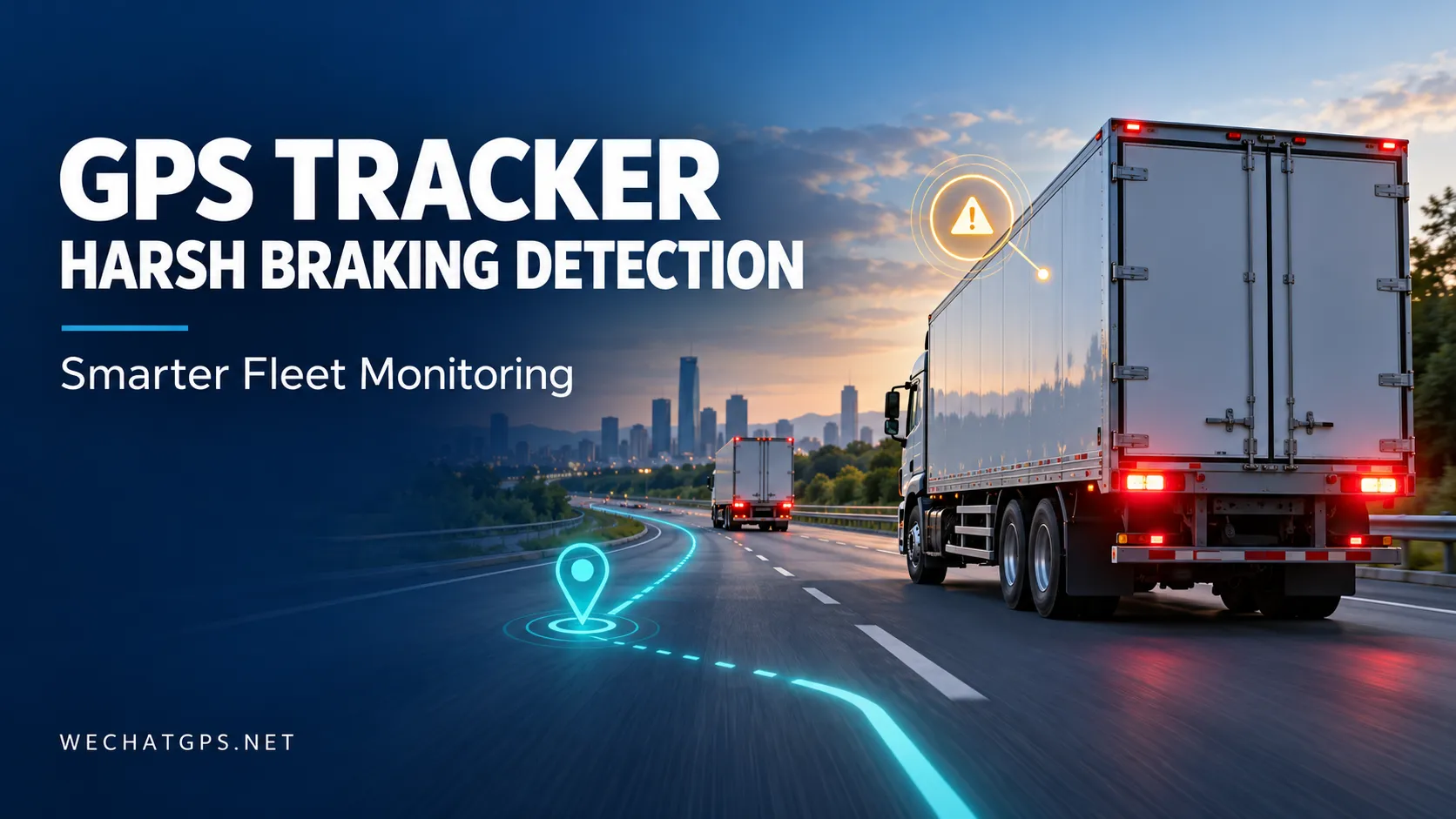
GPS Tracker with Harsh Braking Detection: A Practical Guide for Fleet Buyers
A vehicle’s route history shows where it traveled. It does not always explain how the journey was driven.
For delivery fleets, rental operators and commercial transport companies, sudden braking events can provide useful context when reviewing driving patterns. However, a useful monitoring system needs more than an alert labeled “harsh braking.”
A GPS tracker with harsh braking detection should identify relevant events, record enough information for review and distinguish ordinary driving from sensor disturbances as reliably as the selected hardware allows.
This guide explains how detection works, why false alerts happen and what buyers should verify before ordering devices for a fleet.
What Is a GPS Tracker with Harsh Braking Detection?
A GPS tracker with harsh braking detection combines vehicle location reporting with a method for identifying rapid deceleration.
Depending on the device, the detection source may be:
- An internal accelerometer.
- Changes in GNSS-derived speed.
- A compatible vehicle data interface.
- A combination of supported data sources.
The tracker or platform evaluates those measurements against configured rules. When the conditions are met, the system creates an event for review.
Harsh braking detection should be confirmed separately from ordinary GPS tracking, vibration detection and movement alarms. A device supporting one of these functions does not automatically support the others.
How Does Harsh Braking Detection Work?
Accelerometer-Based Detection
An accelerometer measures acceleration along its sensing axes. To interpret those measurements as vehicle braking, the system needs to account for how the tracker is mounted.
Calibration can help relate the device’s axes to the vehicle’s direction of travel. Filtering and event rules then determine which measurements qualify as braking events.
Manufacturer documentation illustrates why mounting and calibration matter: compatible Teltonika devices use accelerometer calibration to determine installation orientation before evaluating harsh acceleration, braking and cornering. Procedures vary by model and should follow the selected device’s instructions.
GNSS-Speed-Based Detection
Another approach evaluates how quickly reported speed decreases.
For example, a reduction from 60 km/h to 30 km/h over three seconds represents an average deceleration of approximately 2.78 m/s², or 0.28 g.
This is a calculation example, not a recommended alert threshold.
The result depends on the quality and timing of the speed measurements. A platform receiving one location every minute cannot reliably reconstruct every brief braking event from those uploaded points alone.
A compatible tracker may evaluate measurements locally more frequently and upload only qualifying events. Buyers should ask how detection frequency differs from the normal location reporting interval.
Why Do False Braking Alerts Happen?
A sudden sensor measurement does not always represent a braking maneuver.
Potential causes to investigate include:
- Loose installation allowing the tracker to move.
- Incorrect orientation or incomplete calibration.
- Road impacts and strong vibration.
- Poor-quality speed measurements.
- Thresholds unsuitable for the vehicle and operating route.
- Configuration changes made without repeating validation.
The first response should be to inspect the installation and event evidence.
Increasing the threshold immediately may reduce notifications while also making meaningful events harder to detect. The goal is to establish why the system generated the alert.
What Settings Should Fleet Buyers Discuss?
There is no single setting suitable for every fleet. Ask the supplier to explain the available controls and which are supported by the proposed firmware.
| Setting | What to confirm |
|---|---|
| Detection source | Accelerometer, GNSS speed or another supported input |
| Deceleration threshold | Value, unit and method of calculation |
| Event duration | Whether a measurement must persist before triggering |
| Minimum speed | Whether low-speed events are treated differently |
| Ignition condition | Whether detection requires a valid ignition-on state |
| Calibration | Required installation procedure and completion status |
| Event grouping | How repeated measurements become separate or combined events |
| Reporting behavior | Immediate upload, queued upload or scheduled transmission |
These are specification questions. They should not be treated as standard features of every vehicle GPS tracker.
What Should a Braking Event Report Contain?
An alert becomes more useful when an operator can understand its context.
For a fleet project, consider requesting the following fields where supported:
- Vehicle and device identification.
- Event occurrence time.
- Server reception time.
- Event location and location validity.
- Detection source.
- Measured deceleration and its unit.
- Speed information around the event.
- Event duration.
- Relevant configuration version.
Driver identification should be included only when the project has a reliable method of assigning drivers to vehicles.
Separating occurrence time from reception time is especially useful when an event is uploaded after a communication delay.
How to Test the System Before Fleet Deployment
Start with a small pilot covering representative vehicle types and routes.
First, confirm that each tracker is securely installed and calibrated according to its instructions.
Next, collect normal driving records, including routine stops, low-speed maneuvering and typical road conditions. Review unexpected alerts against those journeys.
Any deliberate braking evaluation should follow an approved test procedure in a controlled environment. Record the reference time and conditions so the resulting event can be checked accurately.
The pilot should answer practical questions:
- Did the tracker detect the intended test events?
- Did normal driving generate excessive alerts?
- Were timestamps, locations and units correct?
- Did the platform display the same event information as the device record?
- Were repeated uploads counted only once?
- Did delayed uploads preserve the original occurrence time?
- Did the configuration remain consistent across devices?
Agree on acceptance criteria before placing a production order.
How Should Fleet Managers Use the Results?
Braking events are most useful as prompts for investigation and coaching.
A sudden stop may reflect a pedestrian entering the road, an obstacle or another driver’s actions. A single event does not establish unsafe driving.
For ongoing analysis, review patterns over time and account for vehicle use. Comparing events per 100 kilometers can provide more context than comparing raw totals between vehicles traveling very different distances.
Vehicles operating on urban delivery routes should also be reviewed in the context of their frequent stops and traffic conditions.
Choosing Hardware and Platform Integration
A fleet project needs compatible hardware, firmware and platform processing.
When evaluating a vehicle terminal, confirm the power supply, installation method, ignition input, sensing hardware and event message format. The presence of an accelerometer alone does not prove that validated braking detection is available.
Explore the available GPS tracking products, then request written confirmation of the required detection functions.
For integration projects, discuss event fields, reporting rules and review workflows through the white label GPS tracking platform solution.
Projects requiring a different sensor arrangement, enclosure or firmware behavior can also be evaluated through custom GPS tracker development.
Frequently Asked Questions
Can every GPS tracker detect harsh braking?
No. Support depends on the sensing hardware, firmware, detection rules and platform integration. Basic location reporting alone does not confirm this capability.
Does a vibration alarm mean harsh braking detection is supported?
No. Vibration alarms identify movement or disturbance according to their own rules. Braking detection requires a method for evaluating vehicle deceleration.
Does faster location reporting guarantee better detection?
No. Buyers should distinguish the device’s internal measurement frequency from its upload interval. Detection quality also depends on installation, calibration and processing rules.
Can one configuration be used across an entire fleet?
It may be a starting point for similar vehicles, but it should be validated across the vehicle types and routes included in the deployment.
Discuss Your Fleet Monitoring Requirements
Shenzhen Jinshengchang Technology provides GPS tracking hardware and OEM/ODM development services.
For a harsh braking detection project, share your vehicle types, destination countries, installation requirements, platform interfaces and expected event records. The team can evaluate the appropriate hardware and firmware scope before sample testing.
Contact WECHAT GPS to discuss your fleet project and pilot requirements.
Excellent GPS