Introduction: Why Power Management Is Critical for GPS Trackers
With the rapid development of IoT tracking applications, GPS trackers are widely used in vehicles, assets, livestock monitoring, personal safety, logistics, and industrial equipment.
However, battery life has become one of the biggest challenges in GPS tracker design.
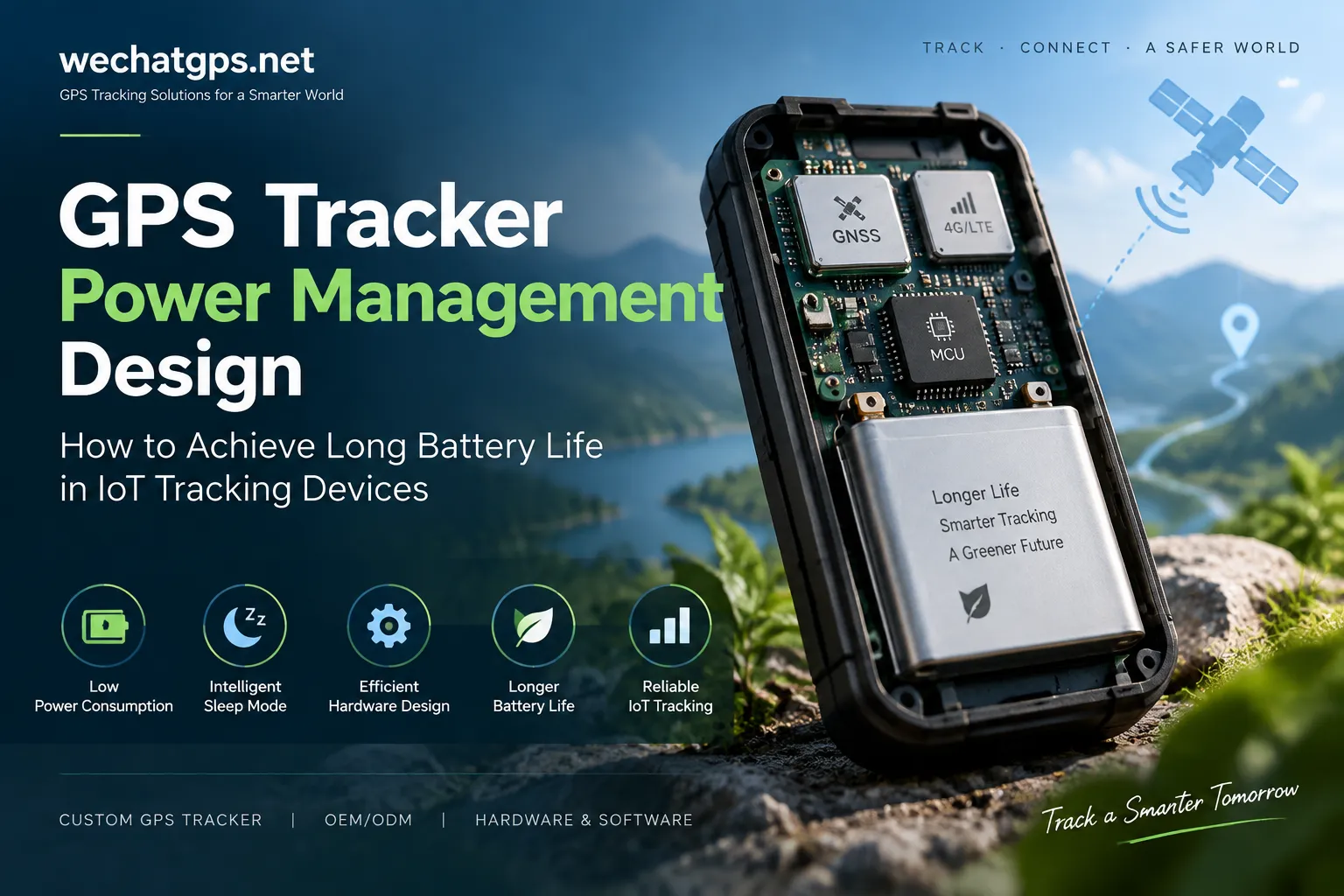
A traditional GPS tracker requires multiple modules working together:
- GNSS positioning module
- Cellular communication module
- Microcontroller (MCU)
- Sensors
- Power management circuit
- Battery system
Each component consumes energy during operation. Without a professional power management strategy, even a large-capacity battery may not achieve long standby time.
Modern GPS tracker design focuses not only on positioning accuracy but also on low power consumption, intelligent wake-up, and optimized communication frequency.
1. Main Power Consumption Sources Inside a GPS Tracker
A GPS tracker does not consume the same amount of power all the time.
The power consumption usually comes from several key components.
GNSS Module Power Consumption
The GNSS module is one of the highest power-consuming parts.
During satellite searching:
- Cold start requires more energy
- Poor signal environments increase working time
- Continuous positioning consumes significant power
For low-power GPS trackers, designers usually use:
- Scheduled positioning
- Assisted GPS (A-GPS)
- Smart location intervals
- GNSS sleep mode
For example:
A vehicle tracker may require continuous tracking, while an asset tracker may only need one location update per day.
Different applications require different power strategies.
2. Intelligent Sleep and Wake-Up Technology
Low-power GPS trackers cannot keep all components active continuously.
A typical design uses:
Deep Sleep Mode
During standby:
- MCU enters sleep mode
- GNSS module powers off
- Communication module disconnects
- Sensors remain in monitoring mode
Power consumption can be reduced from hundreds of milliamps to microamp levels.
Event-Based Wake-Up
Instead of fixed working time, the device wakes up when an event happens.
Examples:
Movement Detection
Using:
- Accelerometer
- Gyroscope
- Vibration sensor
The tracker wakes up when movement is detected.
Applications:
- Asset GPS tracker
- Trailer tracking
- Container monitoring
Geofence Trigger
The device only communicates when:
- Entering a restricted area
- Leaving a defined location
- Abnormal movement occurs
This reduces unnecessary data transmission.
3. MCU Selection in GPS Tracker Development
The MCU is the brain of a GPS tracking device.
A low-power MCU controls:
- GNSS module
- LTE/4G communication
- Sensors
- Battery monitoring
- Data processing
Important MCU features include:
Low Sleep Current
A good MCU should support:
- Deep sleep mode
- Fast wake-up
- Multiple power states
Intelligent Scheduling
The firmware can control:
- When GPS starts
- When data is transmitted
- When sensors work
Good firmware design can significantly extend battery life.
4. Cellular Communication Power Optimization
The communication module is another major power consumer.
Different networks have different power requirements:
4G GPS Tracker
Advantages:
- Wide coverage
- Real-time tracking
- High data speed
Challenges:
- Higher power consumption
Optimization methods:
- Batch data upload
- Reduce unnecessary heartbeat packets
- Optimize TCP connection time
Low Power Communication
For some applications:
- LoRa
- NB-IoT
- LTE-M
can provide longer battery life.
Low-power wide-area technologies are commonly used in IoT applications requiring long-range communication and reduced energy consumption. arXiv
5. Battery Selection for GPS Tracking Devices
Battery design directly affects product performance.
Common battery solutions:
Rechargeable Lithium Battery
Used in:
- Pet GPS trackers
- Personnel GPS badges
- Magnetic GPS trackers
Advantages:
- Rechargeable
- High energy density
- Compact size
Large Capacity Battery
Used for:
- Livestock GPS collar
- Solar GPS tracker
- Industrial asset tracker
Typical solutions:
- 5000mAh
- 10000mAh
- 20000mAh
Solar Power System
For outdoor applications:
- Agriculture
- Mining equipment
- Remote assets
Solar charging can extend operation time significantly.
6. Hardware Design Considerations for Long Battery Life
A professional GPS tracker PCB design should consider:
Power Supply Architecture
Including:
- DC/DC converter
- LDO regulator
- Battery protection IC
- Charging circuit
Separate Power Control
Each module should have independent power control.
Example:
GNSS module:
ON → Position → OFF
4G module:
Connect → Upload → Disconnect
This prevents unnecessary energy waste.
7. Firmware Optimization for GPS Tracker
Hardware alone cannot achieve ultra-low power.
Firmware optimization is equally important.
Common strategies:
Adaptive Tracking Frequency
The device changes positioning frequency automatically.
Example:
Static:
- Update once every 12 hours
Moving:
- Update every 1 minute
Data Compression
Reduce:
- Communication time
- Data volume
- Network cost
Local Data Storage
When network is unavailable:
- Store GPS history
- Upload later
This is important for remote areas.
8. Testing Methods for GPS Tracker Battery Performance
Before mass production, manufacturers should perform:
Current Consumption Test
Measure:
- Sleep current
- GPS working current
- Network transmission current
Battery Life Simulation
Test different scenarios:
Example:
| Mode | Working Time |
|---|---|
| Deep Sleep | 23 hours/day |
| GPS Positioning | 30 minutes/day |
| 4G Upload | 10 minutes/day |
Environmental Testing
Including:
- Temperature test
- Waterproof test
- Signal test
- Battery aging test
9. OEM GPS Tracker Development Requires Complete Engineering Capability
A reliable GPS tracking product requires cooperation between:
- Hardware engineers
- Firmware developers
- Cloud platform developers
- Industrial designers
- Testing engineers
Professional GPS manufacturers usually provide:
- Custom PCB design
- GNSS module selection
- Battery optimization
- Firmware customization
- APP and platform integration
- Mass production support
Conclusion
Long battery life is one of the most important technologies in modern GPS tracker development.
A successful low-power GPS tracker is not achieved only by using a large battery.
It requires:
- Efficient hardware architecture
- Low-power MCU design
- Intelligent firmware
- Optimized communication strategy
- Proper battery management
From small pet GPS devices to large industrial asset trackers, power optimization determines the final user experience and product competitiveness.
Professional GPS tracker OEM development can help companies create customized tracking solutions for different industries.
Recommended related products: