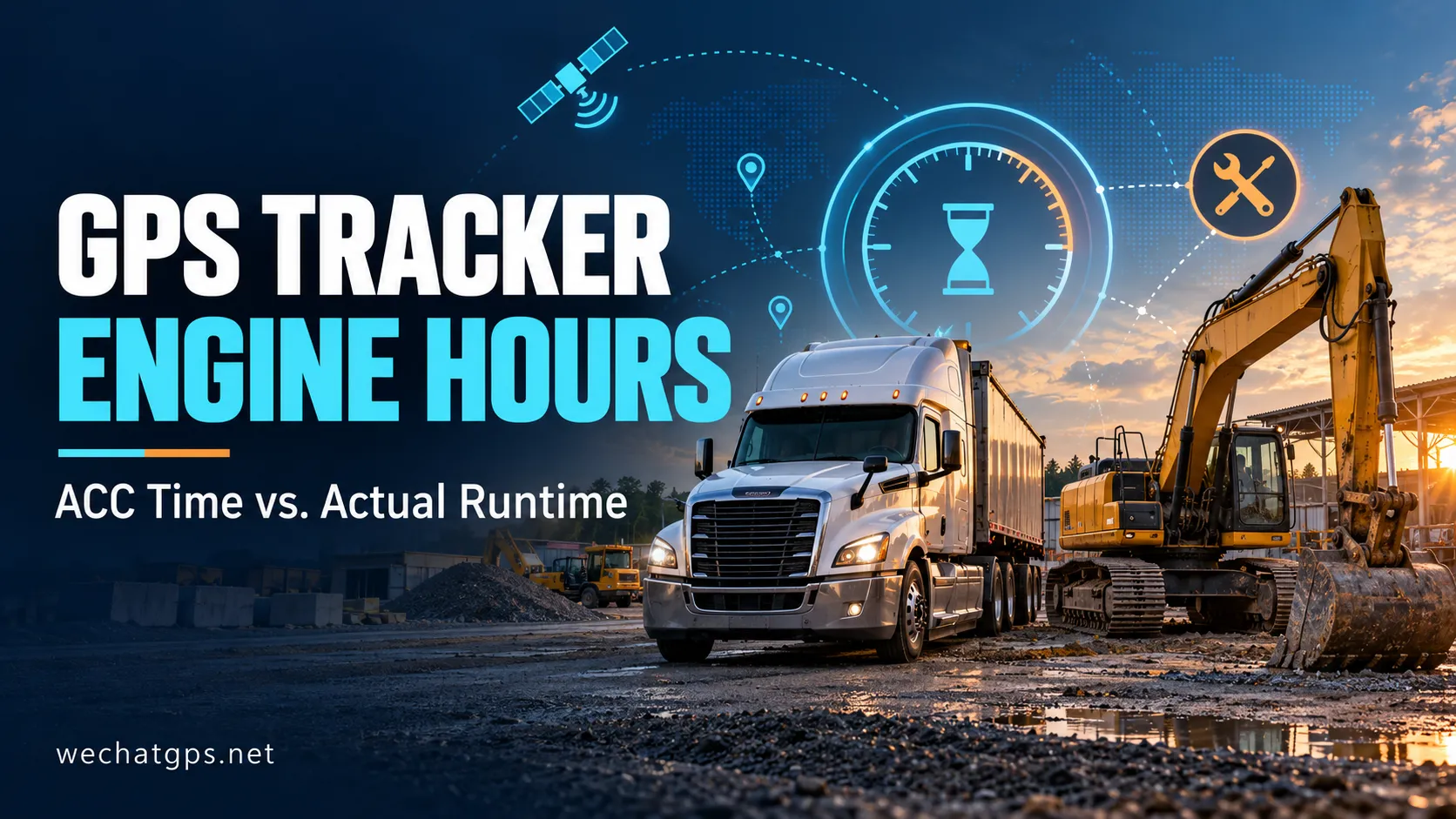
A vehicle can remain in one place while its engine runs for several hours. A generator may operate all day without traveling a single kilometer. For these assets, location and mileage alone cannot show how long the engine has been operating.
GPS tracker engine hours can help businesses plan maintenance and understand equipment use. However, the usefulness of the report depends on how the system detects engine operation.
Before choosing a tracker, buyers should ask: does the system record ignition-on time, confirmed engine runtime, or movement time?
What Are GPS Tracker Engine Hours?
An engine-hours report adds together the periods during which the tracking system considers the engine to be running.
GPS satellites provide positioning information. Engine operating status must come from another source, such as a wired input or compatible vehicle data interface.
If the tracker uses an ignition input, the resulting total may represent ignition-on hours. If it receives a valid engine-running signal, the report can more closely represent actual runtime.
The report should identify its measurement source so that operators know what the number means.
ACC Time and Engine Runtime Are Different
A GPS tracker with ACC detection can record when its connected ignition signal changes between on and off.
However, the signal depends on the circuit used during installation. An accessory circuit may become active while the engine remains stopped, and some circuits change state during cranking.
Consider a hypothetical working day:
- The ignition is switched on for 20 minutes before the engine starts.
- The engine runs for four hours.
- The ignition remains on for another ten minutes after shutdown.
An ignition-based counter could record four hours and 30 minutes, while actual engine runtime is four hours.
Neither figure should be presented without context. Ignition-on duration may help investigate vehicle use, while engine runtime is more relevant when a maintenance schedule specifically depends on operating hours.
Ways to Detect Engine Operation
Wired Ignition or Digital Input
A wired input is a practical starting point for monitoring ignition status.
Installation should follow the vehicle wiring diagram and tracker input specification. Test the selected circuit with the key off, accessory power on, during starting, and while the engine runs.
For an introductory product option, see the 4G wired vehicle GPS tracker, which lists ACC detection. Confirm the required hours report and counting logic separately when specifying a project.
Compatible CAN or OBD Data
When supported by both the tracker and vehicle, engine data can provide a more direct indication of operation.
For example, valid engine-speed data can help distinguish a running engine from a vehicle with its ignition switched on. Some compatible systems may also provide an existing engine-hours counter.
Availability varies by vehicle, interface and device configuration. Buyers should request a compatibility check for the exact model rather than assume every vehicle exposes the same information.
Voltage or Vibration Estimates
Some tracking systems infer ignition or activity from supply voltage or an accelerometer.
These methods require field validation. Charging conditions can affect voltage, while transport and external vibration can resemble equipment activity.
When the source is an estimate, name the report accordingly and compare it against an independent runtime reference before relying on it.
Runtime Does Not Equal Productive Working Time
An engine-hours report records operation according to a defined signal. It does not automatically show how much useful work the equipment completed.
An excavator may run while waiting for a truck. A vehicle may idle during loading. A stationary generator may be supplying power throughout its operating period.
For project specifications, separate these concepts:
| Metric | What it measures |
|---|---|
| Ignition-on hours | Time the selected ignition signal is active |
| Engine runtime | Time a validated engine-running condition is present |
| Moving time | Time a defined movement condition is present |
| Productive working time | Time a task-specific work condition is present |
Productive-time monitoring may require additional signals, such as power output or hydraulic activity, depending on the equipment.
Define How the Counter Works
A useful specification should state:
- Which input or data field starts and stops counting.
- Whether counting happens inside the tracker or on the server.
- What happens during loss of cellular coverage.
- Whether the total survives a device restart.
- How device replacement and counter resets are handled.
- How missing or stale data appears in reports.
Counting only from widely spaced server reports can leave uncertainty around start and stop times.
Where the selected device supports local counting, a cumulative counter can help preserve operating totals during network interruptions. This requires firmware support and should be confirmed through testing.
Use Hours Reports for Maintenance Planning
Start with the equipment manufacturer's maintenance schedule and an agreed baseline.
For example, suppose a machine was serviced at 1,200 hours and its specified next service interval is 250 hours. The next hours-based service point is 1,450 hours.
If the verified current total is 1,420 hours, 30 hours remain before that service point.
This is an illustrative calculation, not a universal service interval. Maintenance may also depend on calendar time, mileage and operating conditions.
Keep the baseline, service date and measurement source together. A new tracker should not silently reset the equipment's maintenance history to zero.
Test Before Deploying Across a Fleet
A pilot should include ignition on with the engine stopped, normal running, stationary running, shutdown, network loss and a tracker restart.
Compare reported totals against an independent reference such as a validated machine hour meter. Define the acceptable difference before the trial, based on the intended use.
For equipment that continues operating while stationary, confirm that runtime counting remains active even when GPS speed is zero.
Custom Engine-Hour Tracking Projects
Shenzhen Jinshengchang Technology Co., Ltd. provides vehicle trackers and OEM/ODM development services.
For an engine-hour monitoring project, provide the equipment model, available signals, electrical system, operating region and platform requirements. Specify whether the required report is ignition-on duration, actual engine runtime or productive working time.
The existing 4G vehicle GPS tracker provides an ACC-capable starting point for discussing the project. CAN/OBD compatibility, persistent hour counters and maintenance reminders should be confirmed in the agreed specification.
Frequently Asked Questions
Can a GPS tracker measure engine hours using location alone?
Location alone cannot reliably establish engine runtime. Stationary equipment may be running, while equipment being transported may move with its engine stopped.
Does ACC detection guarantee accurate engine hours?
ACC detection records the selected electrical signal. Its relationship to actual engine operation depends on the circuit and counting logic.
Can runtime be recorded without cellular coverage?
It can be, if the selected tracker supports local counting and retains the total for later upload. Confirm this behavior in the pilot.
Can engine-hours reports support maintenance reminders?
Yes, when the measurement source, baseline and reporting behavior have been validated and the platform supports the required reminders.
Recommended GPS Products