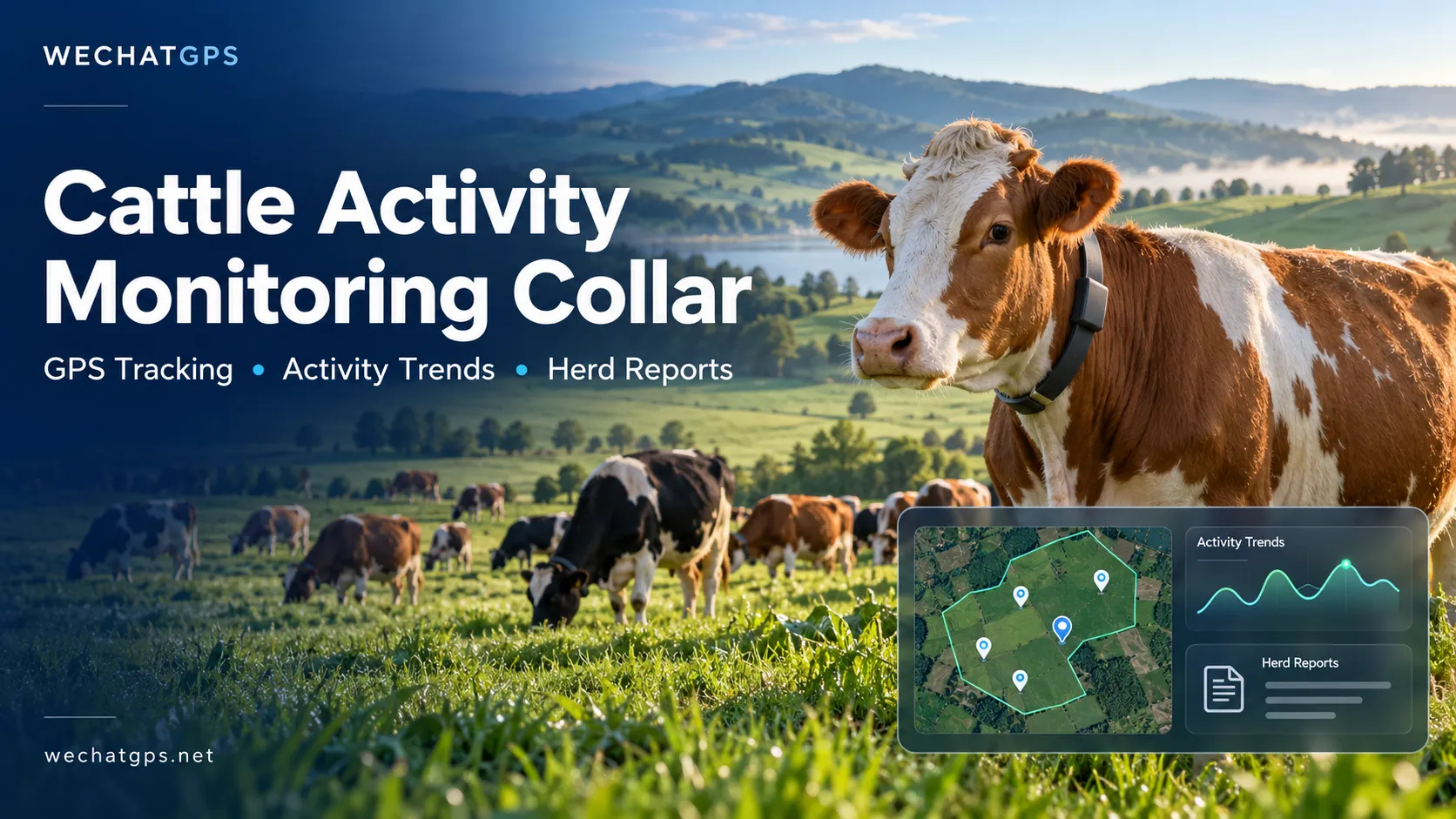
Knowing where cattle are is only the beginning of digital pasture management. Farmers also need to decide which animals require attention, whether a herd is using the expected grazing area, and whether an unusual record reflects animal behavior or a device problem.
A cattle activity monitoring collar can bring location and movement information into the same management workflow. Its value depends on the quality of the data, the meaning of each indicator, and how clearly the platform presents exceptions.
This guide explains what to specify when choosing a collar and planning activity reports for a working ranch.
What Is a Cattle Activity Monitoring Collar?
A cattle activity monitoring collar is a wearable livestock device that combines animal identification with movement-related information. A GPS-enabled version also records positions, allowing managers to review where an animal was during a selected period.
Location and activity are different measurements. GPS positions describe movement across the pasture. Motion sensors, where fitted and supported by firmware, provide additional information about movement of the collar itself.
Before buying, confirm whether the device sends raw sensor readings, summarized activity values, or only movement events. These options support different levels of analysis.
What Can Farmers Learn from the Data?
An effective platform should help operators answer practical questions:
- Where was this animal last located, and how recent is that position?
- Has its recorded activity changed compared with its usual pattern?
- Is it inside the assigned pasture?
- Does an unusual pattern affect one animal or much of the herd?
- Is the collar communicating normally?
A movement change is a reason to review the animal and its circumstances. It does not, by itself, explain the cause.
For example, a low-activity record may coincide with a normal resting period, a detached collar, missing measurements, or an animal needing inspection. The platform should show supporting evidence before assigning urgency.
Use Individual Baselines for Activity Alerts
A single threshold applied to every animal can create unnecessary notifications. Different animals, groups and pasture conditions may produce different activity patterns.
A useful customization approach is to build an individual baseline from several representative days of valid data. Compare the current period with similar periods in that animal’s history.
Farm teams should agree how long a change must persist before generating an alert. They should also decide what happens after a pasture transfer, collar replacement or reporting-interval change.
Baseline comparison is a proposed analytics method that must be configured and tested. It should not be presented as an included feature of every GPS collar.
Distinguish Inactivity from Missing Data
No new data is not the same as no movement.
When a collar stops uploading, the platform cannot assume that the animal has remained still. Likewise, repeated coordinates alone may not establish inactivity if the positions are stale or have limited quality.
Keep the following conditions separate:
| Condition | What the platform should check | Suggested response |
|---|---|---|
| Reduced recorded activity | Valid samples, comparison period and duration | Review the animal’s recent pattern |
| Little recorded position change | Position timestamps and location quality | Inspect the location and context |
| Device offline | Last communication and expected upload interval | Investigate connectivity and power |
| Low battery | Latest battery reading and reporting profile | Plan device maintenance |
| Unexpected boundary crossing | Valid position and assigned geofence | Check the animal’s whereabouts |
A useful alert includes the animal ID, collar ID, event time, last valid position and latest communication time. These details help staff decide what to inspect first.
What Should a Herd Activity Report Include?
A ranch dashboard provides the current overview. A report explains what happened during a chosen period.
Specify filters for ranch, pasture, herd, animal type and date range. Keep historical group assignments where animals move between pastures, so earlier records are interpreted in the correct context.
A practical report can include:
- Animals assigned to the selected group.
- Animals with valid data during the period.
- Activity summaries, where supported.
- Estimated travel distance from validated GPS records.
- Inactivity and boundary events.
- Offline periods and battery warnings.
- Staff inspection notes and handling status.
Distance calculated from intermittent GPS reports is an estimate. Position noise and gaps can distort the result, so reports should describe the calculation and flag incomplete periods.
Avoid filling missing activity values with zero. Display “insufficient data” when the available records cannot support a reliable comparison.
Choosing a Solar GPS Collar for Pasture Use
The JSC-805 Solar 4G GPS Cattle Tracking Collar provides cellular location reporting, geofencing, route history, activity and inactivity monitoring, solar charging, and mobile or web management.
For an activity-focused project, confirm the exact sensor configuration, firmware output and available platform functions. A product’s general activity-monitoring description does not establish that it includes validated grazing, rumination or lying-time classification.
Match reporting frequency to the job. Routine herd visibility and investigating an exception may require different upload schedules. Test battery performance and communication in the actual grazing environment.
Activity Monitoring and Vital Signs Are Different
Movement monitoring can support livestock inspection, but it does not directly measure heart rate, breathing rate or core body temperature.
A temperature or humidity reading must be labeled according to the sensor’s placement and intended measurement. A sensor inside an enclosure or exposed near the neck should not automatically be described as measuring core body temperature.
Likewise, detailed behavior labels require suitable sensors, algorithms and field validation. Start with indicators the hardware can demonstrate, then expand the analytics after testing.
Plan a Pilot Before Scaling Up
Choose a representative group and compare platform records with farm observations. Include normal grazing, resting, pasture transfers and periods of weak connectivity.
During the pilot, measure data completeness, notification delay, unnecessary alerts and battery behavior. Ask staff whether each alert contains enough information to support an inspection.
For branded dashboards, APIs and tailored reports, the White Label GPS Tracking Platform provides a starting point for defining the required software scope. Confirm livestock-specific analytics and report fields in the project specification.
Discuss Your Cattle Monitoring Project
Shenzhen Jinshengchang Technology Co., Ltd. supplies livestock GPS devices and customized tracking solutions.
Share your deployment country, herd size, pasture layout, communication conditions and reporting requirements. If activity analytics are needed, also specify the sensor data, indicators and inspection workflow you expect.
The goal is a cattle activity monitoring system that helps farm teams locate animals, review meaningful changes and act on records they can understand.
Frequently Asked Questions
Can GPS alone identify grazing or rumination?
GPS can show location and estimated travel patterns. It does not directly establish grazing or rumination. Reliable behavior classification needs an appropriate sensing and validation approach.
Does a stationary GPS position mean the animal is unwell?
No. Check the position’s age, data quality, activity records and farm observations before drawing conclusions.
Can activity reports cover several ranches?
They can be included in a customized platform scope. Define ranch permissions, herd assignments, date filters and export requirements before development.
Is solar charging enough to guarantee continuous operation?
No. Solar contribution and power consumption vary with exposure, installation, reporting settings and operating conditions. Validate the intended configuration during the pilot.