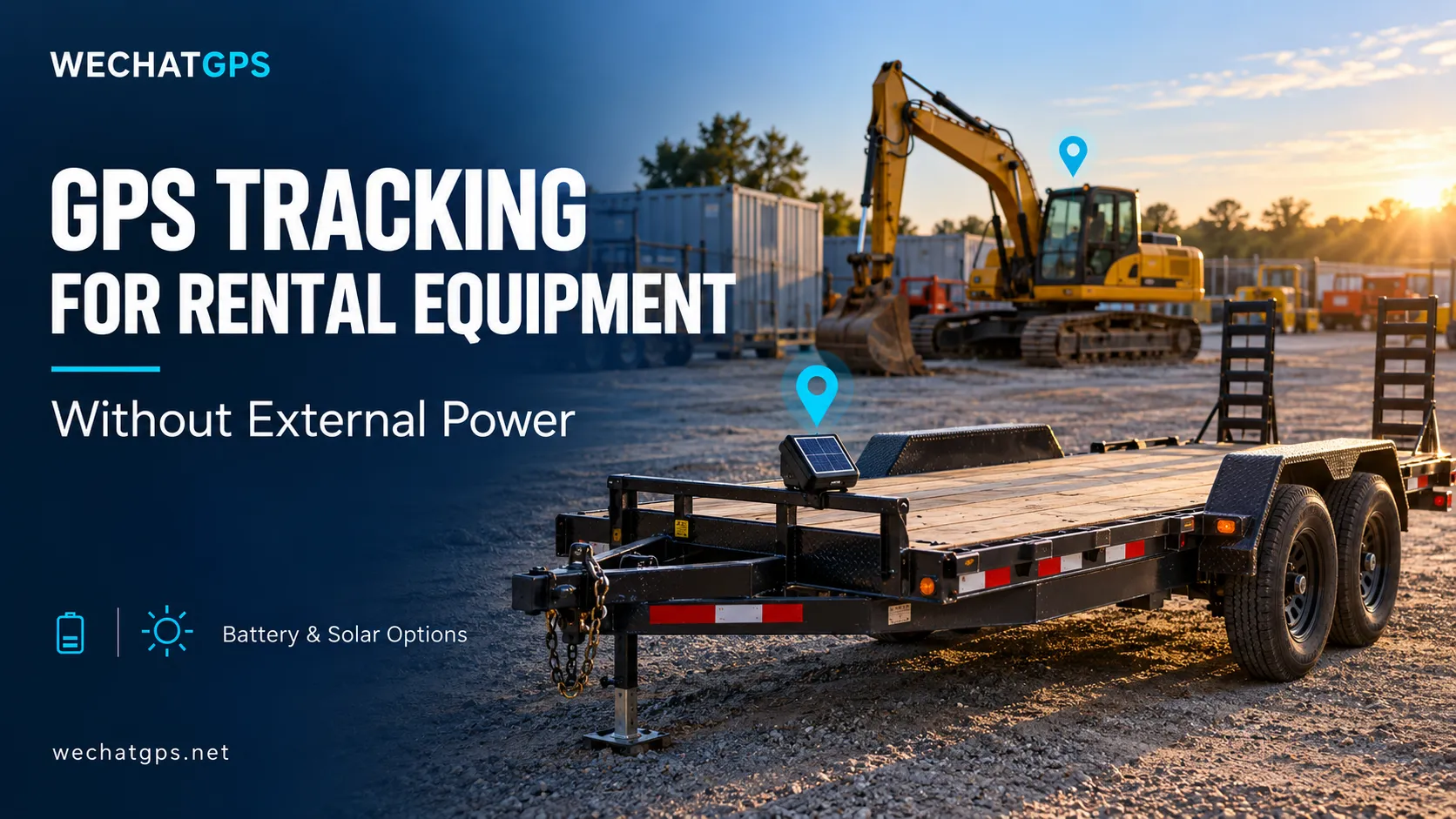
Rental equipment often moves between storage yards, customer sites and temporary projects. Keeping an accurate record of those movements becomes difficult when the equipment has no accessible electrical supply.
A trailer may remain disconnected from its towing vehicle for weeks. A rental attachment may have no battery at all. Even powered machinery may spend long periods parked with its main battery isolated.
A GPS tracker for rental equipment without external power provides an independent way to report location. For rental businesses, the purchasing decision should start with a practical question: what information does the team need between dispatch and return?
Which Rental Assets Need Independent Tracking?
Self-powered tracking is worth evaluating for assets such as:
- Utility trailers and equipment transport trailers.
- Excavator attachments and detachable machinery accessories.
- Portable storage containers.
- Towable equipment parked between projects.
- Seasonal agricultural implements.
- Outdoor rental assets stored across several locations.
These assets do not all require continuous tracking. A rental manager may simply need to confirm delivery, identify unexpected movement and locate equipment before collection.
Define those tasks first. They determine the required reporting schedule, mounting method and platform workflow.
Battery or Solar: Which Configuration Fits the Fleet?
Both approaches remove dependence on the equipment’s electrical system, but they create different maintenance requirements.
| Operating condition | Configuration to evaluate | Main purchasing question |
|---|---|---|
| Equipment regularly returns to a depot | Rechargeable battery tracker | Can charging become part of the return inspection? |
| Equipment stays outdoors for extended rentals | Solar-assisted tracker | Will the installed panel receive enough daylight? |
| Equipment spends time under roofs or covers | Battery-powered tracker | Can it complete the rental period without charging? |
| Equipment moves frequently between customers | Battery or solar, depending on exposure | What reporting frequency is needed during transport? |
For outdoor deployments, the Solar Asset GPS Tracker provides a product option to evaluate. Its published features include solar-assisted charging, scheduled reporting, movement alerts and battery monitoring.
Solar charging still requires a suitable installation. A panel shaded by the equipment itself may contribute little energy, even when the asset is technically outdoors.
Build Tracking Around the Rental Cycle
A useful rental tracking workflow follows the asset through four stages.
1. Prepare the Equipment for Dispatch
Before handing equipment to a customer, associate the tracker’s device ID with the rental asset number.
The dispatch record should include:
- Equipment identification.
- Assigned tracker.
- Battery status.
- Latest valid location and timestamp.
- Rental destination.
- Planned return date.
Check that the device is reporting before the equipment leaves the yard. Finding a registration error after delivery can require an unnecessary site visit.
2. Confirm Delivery to the Customer Site
The platform should help staff compare the reported position with the expected destination.
A location report near the customer site can support delivery verification, but it should not automatically replace signed delivery records. The tracker may be mounted on a transport trailer, or the equipment may still be waiting outside the site.
For larger projects, define an operating area that reflects the actual site boundary rather than using a very small circle around one map point.
3. Monitor the Active Rental
During the rental, focus on events that staff can act on.
Examples include unexpected movement outside agreed hours, departure from the assigned site and declining tracker battery level.
Alert schedules should follow the rental agreement. Equipment operating on a night shift should not generate the same movement notifications as equipment expected to remain parked overnight.
4. Plan Collection and Reassignment
Before collection, check both the latest position and its age.
A map marker recorded yesterday may be insufficient for locating equipment moved this morning. Where the selected device supports it, a temporary increase in reporting frequency can help during the collection period.
After return, inspect the tracker, recharge it if necessary and confirm its assignment before the next rental.
Ask How Quickly Alerts Can Actually Arrive
“Movement alert” does not by itself describe end-to-end performance.
Before purchasing, ask the supplier:
- Does movement wake the device from sleep?
- How is a movement event distinguished from vibration?
- When does the device attempt to obtain a fresh position?
- What happens if the cellular connection is unavailable?
- How does the platform deliver notifications?
- Can the user see when the reported event actually occurred?
Remote commands also need clarification. A sleeping device may receive a new reporting instruction only when it reconnects, depending on its design.
For rental operations, these details matter more than a long list of alert names.
Make Equipment Identity Clear on the Platform
Staff should be able to find “Trailer T-024” without remembering a tracker serial number.
A practical setup links each device to an asset record containing its equipment category, rental status, assigned customer site and maintenance notes.
If the rental company already uses management software, define the required integration before ordering. Useful data may include the last valid position, location timestamp, battery status and movement events.
Also decide how reassignment works. Moving one tracker between assets without updating the records can create a convincing but incorrect location history.
Test the Mounting on the Actual Equipment
Rental equipment experiences handling, loading, cleaning and transport. The installation must suit those conditions.
Check that the proposed location:
- Does not interfere with moving parts or lifting points.
- Provides suitable conditions for positioning and communication.
- Protects the device from foreseeable impacts.
- Allows inspection and charging when required.
- Gives a solar panel adequate exposure, if fitted.
A magnet-based installation should be evaluated on the actual mounting surface and under expected vibration. Confirm whether a bracket or additional retention is needed for the application.
Run a Pilot Through a Complete Rental Cycle
A depot demonstration cannot show every condition the tracker will face.
Use a small pilot covering dispatch, road transport, customer-site storage and return. Include different equipment types and installation positions.
Record whether staff could locate the correct asset, how old the location data was, whether useful alerts arrived and how the battery changed during the trial.
Agree acceptance criteria before testing. For example, define the maximum acceptable age of a parked asset’s location and the required notification time for an unexpected movement event. These are project targets to validate, rather than assumptions to make from a product title.
Request a Configuration for Your Rental Fleet
Shenzhen Jinshengchang Technology Co., Ltd. offers asset tracking products and project-based customization through WECHATGPS.
Start with the asset GPS tracker product range, then provide your equipment type, deployment country, typical rental duration, installation photos and required update frequency.
For outdoor equipment, the solar-assisted option can be evaluated alongside battery-powered configurations. Final hardware, reporting behavior and platform requirements should be confirmed for the selected device.
The right tracker should fit the way your equipment is dispatched, used and returned—while giving your team location information it can act on.
Frequently Asked Questions
Can a GPS tracker work when rental equipment has no battery?
Yes. A tracker with its own battery can operate independently of the equipment’s electrical system. Its operating duration must be evaluated against the required reporting schedule and deployment conditions.
Is solar charging suitable for every rental asset?
No. Solar-assisted charging is most useful when the installed panel receives sufficient daylight. Equipment stored indoors, covered during transport or frequently shaded needs a different power assessment.
Does a location tracker measure equipment operating hours?
Location reports alone do not establish engine hours or productive working time. If those records are required, specify the necessary sensors, electrical inputs or equipment-data integration separately.
What should a rental company send when requesting a quotation?
Provide the quantity, country, asset types, rental duration, desired reporting frequency, mounting requirements and platform integration needs. Installation photos help the supplier assess a realistic configuration.