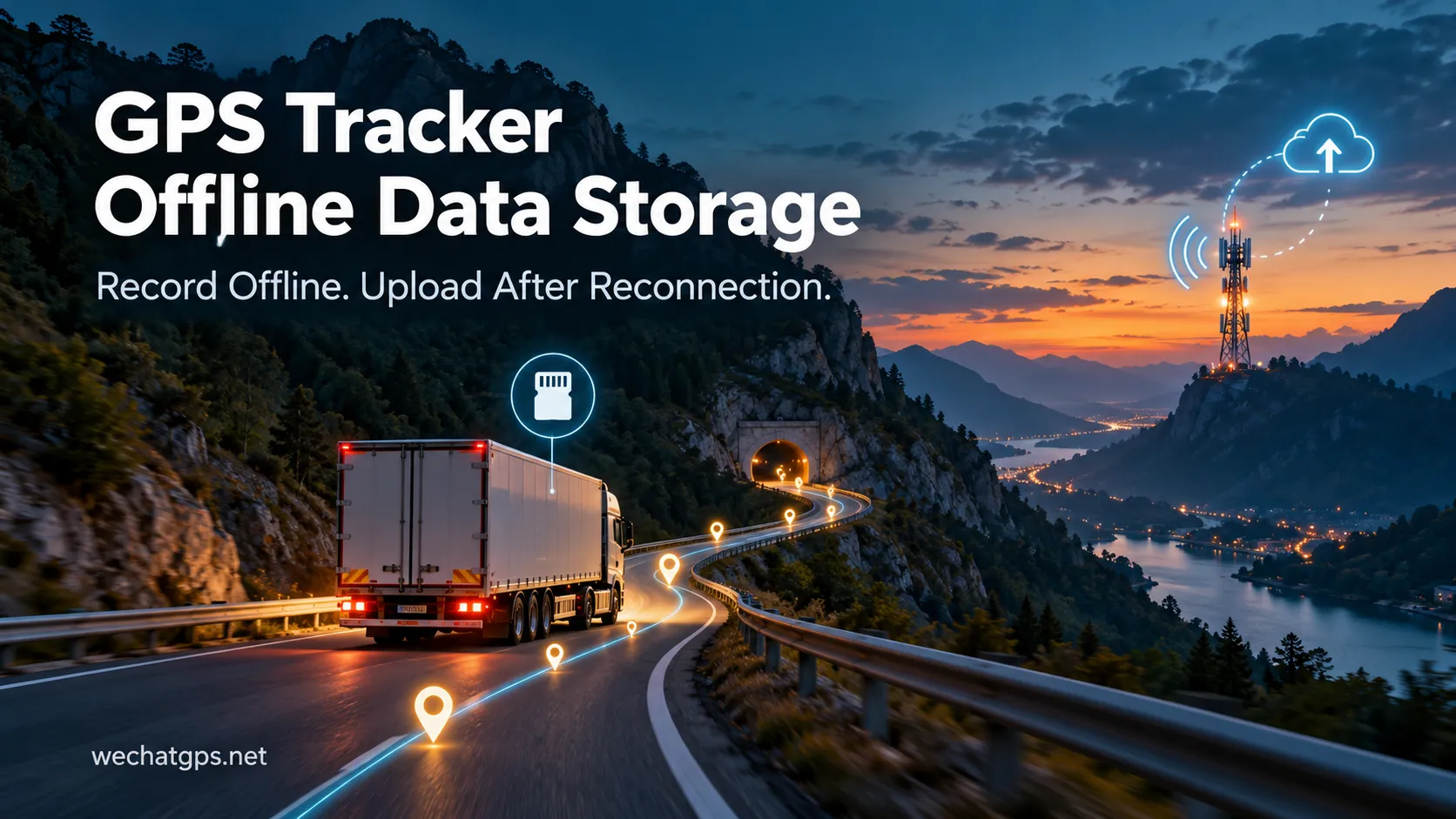
A vehicle enters a rural road, a delivery truck passes through a tunnel, or a piece of equipment operates beyond cellular coverage. On the tracking platform, its location stops updating.
Does this mean the GPS tracker has stopped recording?
Not necessarily. A device with GPS tracker offline data storage can save location records locally and upload them after the cellular connection returns. However, this capability depends on the hardware, firmware, storage configuration and tracking platform.
Understanding these details helps businesses avoid missing routes and choose equipment suited to real operating conditions.
GPS Positioning and Cellular Communication Serve Different Purposes
A cellular GPS tracker performs two separate tasks.
First, its GNSS receiver calculates a position using satellite signals. Second, its cellular modem sends that information to a remote server.
A tracker may receive satellite signals while having no usable cellular connection. On an open rural road, for example, the device may continue calculating positions even though it cannot send them to the platform.
The reverse can also happen. Inside a covered parking structure, a tracker may remain connected to the cellular network while being unable to obtain a fresh satellite position.
This distinction matters when investigating an offline device. A missing platform update alone does not establish whether positioning, communication or power has failed.
What Is GPS Tracker Offline Data Storage?
GPS tracker offline data storage is a device feature that keeps records in local memory when immediate transmission is unavailable.
Depending on the implementation, a stored record may include:
- Device identification
- Original positioning timestamp
- Latitude and longitude
- Speed and direction
- Position validity or positioning source
- Ignition status
- Battery or external power information
- Event codes and record sequence numbers
When connectivity returns, the tracker can transmit the pending records to the server. This process is often called store-and-forward tracking or historical data backfill.
Local storage must be explicitly supported. A tracker that sends live positions does not automatically provide reliable offline recording.
What Happens During a Coverage Gap?
Consider a delivery vehicle that loses cellular service at 10:00 and reconnects at 10:25.
If the tracker continues obtaining valid positions and is configured to save one record every 30 seconds, approximately 50 records could accumulate during that period.
After reconnection, the device may send those records in batches while resuming current updates.
The platform should then place the historical points on the route according to their original positioning times.
This is an illustrative example. Actual recording and upload behavior depends on device settings, available memory, power management and network conditions.
Offline storage can help recover the journey history. It cannot make the vehicle visible in real time while the communication path is unavailable.
Cellular Signal Loss and GPS Signal Loss Produce Different Results
| Operating condition | What may happen |
|---|---|
| Satellite position available, cellular connection unavailable | Valid location records may be saved for later upload |
| Cellular connection available, satellite position unavailable | Status updates may continue without a fresh GNSS position |
| Both satellite positioning and cellular communication unavailable | The device may store status or event records, depending on firmware |
| Device loses power | Recording stops unless a suitable backup power source remains available |
A tunnel illustrates the limits of offline storage. If the tracker cannot obtain satellite positions inside the tunnel, memory alone cannot recreate the missing route.
Some systems offer alternative positioning or dead reckoning, but these are separate capabilities that must be specified and tested.
How Much Offline Storage Does a Project Need?
Storage requirements depend on the recording interval and the longest expected communication outage.
A useful starting calculation is:
Required records = outage duration in seconds ÷ recording interval in seconds
For a 24-hour outage:
| Recording interval | Approximate location records |
|---|---|
| 10 seconds | 8,640 |
| 30 seconds | 2,880 |
| 60 seconds | 1,440 |
| 5 minutes | 288 |
These figures exclude additional events and storage overhead.
Ask the supplier for the usable record capacity under the selected firmware configuration. A memory size stated in megabytes does not, by itself, establish how many days of history the device can retain.
Also confirm what happens when storage becomes full. Possible behaviors include overwriting the oldest records, stopping new recording or applying different priorities to location and alarm data.
Reliable Upload Requires More Than Local Memory
Saving records is only part of the process. The tracker and platform must transfer and process them correctly.
Preserve the Original Timestamp
Historical points should retain the time when they were recorded.
If the server uses the upload time as the positioning time, a route collected over several hours could appear as a cluster of updates received within minutes.
The platform should distinguish between event time and server receipt time.
Confirm Server Receipt
A robust implementation uses acknowledgements so that the device knows which records the server has accepted.
Without suitable confirmation and retry logic, a connection interruption during upload can leave gaps in the recovered history.
Handle Duplicate Records
Retries may cause the same record to arrive more than once.
The server should identify duplicates using suitable fields, such as device identity, sequence number and timestamp. Otherwise, repeated records may affect route playback or operational reports.
Balance Historical and Current Updates
A large backlog can take time to transmit.
The upload strategy should define how historical records share the connection with current locations and new events. This is particularly relevant when many devices reconnect after a network outage.
Offline Alarms Need Clear Time Labels
An event may occur while a tracker has no communication service.
For example, a supported device could record a power-disconnection event locally and transmit it after reconnecting. The platform should show both when the event occurred and when it was received.
The same principle applies to geofence events, but the processing method matters.
A device with local geofence logic may record a boundary crossing itself. A platform that calculates geofence events from uploaded positions may identify the crossing only after historical data arrives.
Neither method guarantees an immediate remote notification during a communication outage.
Applications That Benefit from Offline Recording
Rural Fleet Operations
Vehicles that regularly cross coverage gaps can use stored records to support later route review and trip reconstruction.
Construction Equipment
Machinery may work in remote sites with intermittent cellular service. Offline recording can help preserve operating history when the selected tracker supports the required inputs and events.
Cross-Border Transport
Roaming registration delays or network changes can interrupt transmission. Local recording can reduce historical gaps while communication is restored.
Livestock Tracking
A cellular livestock collar may retain scheduled outdoor positions during temporary coverage loss if its firmware supports this behavior.
Storage does not replace coverage planning. Projects that require timely remote alerts still need a communication method suited to the operating area.
How to Test GPS Tracker Offline Data Storage
Before a larger deployment, run a controlled pilot using the intended device, SIM card, firmware and platform.
- Confirm that the tracker is online and reporting valid positions.
- Create a controlled cellular interruption while maintaining device power and satellite reception.
- Record the test route and the interruption times independently.
- Restore communication.
- Check whether the historical records arrive automatically.
- Compare recovered timestamps and positions with the reference journey.
- Check for missing records, duplicates and incorrect route order.
- Restart the device during a separate offline test to check whether pending records survive.
- Test the documented behavior when storage approaches capacity.
Use an approved test configuration or a naturally occurring coverage gap. Disconnecting the tracker’s power would test a different failure condition.
Questions to Ask Before Ordering
When evaluating a GPS tracker, ask:
- Does this exact model and firmware support offline location storage?
- How many usable records can it retain?
- Does recording continue at the configured interval without cellular service?
- Are pending records retained after a restart?
- What happens when memory is full?
- Does the server acknowledge historical uploads?
- How does the platform handle duplicate and delayed records?
- Are live updates prioritized during backlog transmission?
- Which alarm events can be saved locally?
- Can historical records be accessed through the API?
These questions turn a general feature claim into requirements that can be verified during sample testing.
Planning a Tracking Solution with WECHATGPS
A complete tracking project should define what happens during normal operation, communication loss and recovery.
For vehicle applications, explore the 4G wired vehicle GPS tracker and confirm offline storage, usable record capacity and upload behavior for the selected configuration.
For integration projects, a white-label GPS tracking platform can be evaluated against requirements for historical data processing, event timestamps, route playback and API access.
When discussing your project, provide the expected coverage gaps, recording interval, maximum outage duration and reporting requirements. These details help define a practical offline recording and recovery strategy.
Frequently Asked Questions
Can a GPS tracker record locations without cellular service?
Yes, if it continues receiving usable satellite signals and supports local offline recording. Those positions can be uploaded after communication returns.
Can I see the tracker live while it is offline?
A cellular-only tracker cannot deliver live updates without a working cellular data connection. The platform generally shows the last received position until communication resumes.
Does offline storage work without a SIM card?
Some devices may record locally without an active SIM, while others require specific provisioning or operating settings. Confirm this behavior for the exact model. Uploading over a cellular network still requires suitable service.
Will stored data disappear when the tracker restarts?
This depends on the storage design and firmware. Ask whether pending records are retained in nonvolatile memory and verify the behavior during testing.
Does offline data storage increase power consumption?
Recording and later transmitting data use energy. The effect depends on positioning frequency, memory operations, network retry behavior and backlog size. Battery-powered projects should be tested under representative coverage conditions.