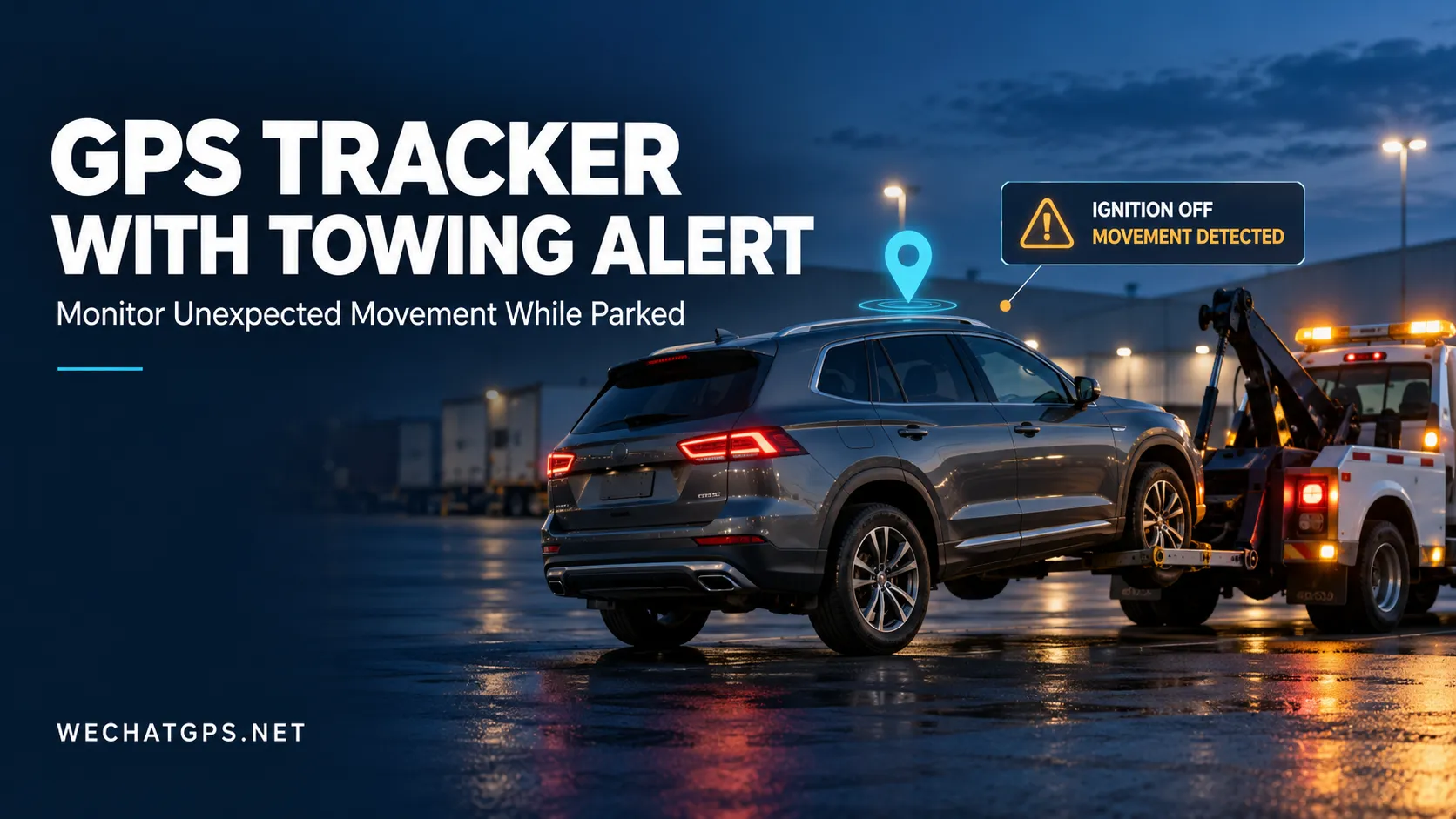
A parked vehicle can move without its engine starting. It may be lifted onto a recovery truck, towed from a storage yard or transported without the fleet manager’s knowledge.
Ordinary trip records may not explain these events, especially when the ignition remains off.
A GPS tracker with towing alert helps identify unexpected movement while a vehicle is parked. For rental companies, vehicle finance providers and commercial fleets, this adds a useful monitoring function between normal journeys.
The value depends on how the device detects movement, how quickly it reports the event and what information reaches the person responsible.
What Is a GPS Tracker with Towing Alert?
A GPS tracker with towing alert is a vehicle tracking device configured to recognize movement under conditions that suggest towing or unauthorized relocation.
Depending on the hardware and firmware, detection may use:
- Ignition status.
- Accelerometer activity.
- Changes in device angle.
- Sustained movement.
- Changes in valid satellite positions.
These inputs provide different evidence. An accelerometer can detect physical movement before a fresh GPS position becomes available. Satellite positioning can help establish where the vehicle subsequently travels.
A towing alert should therefore be treated as a reason to investigate. It does not independently prove theft or identify who moved the vehicle.
How Does Vehicle Towing Detection Work?
One established approach combines ignition-off status with accelerometer monitoring after a configurable activation delay. Movement or changes in angle must meet the configured conditions before the device generates an event. Exact behavior varies by tracker model.
For a fleet deployment, a suitable operating sequence might be:
- The ignition switches off.
- A parking delay allows passengers to leave and doors to close.
- The tracker activates its parked-vehicle monitoring mode.
- Sustained movement triggers a suspected towing event.
- The device attempts to report the event and obtain an updated position.
- The platform notifies the assigned operator.
This sequence should be confirmed during product selection. A tracker offering vibration alerts does not automatically provide a complete towing-detection function.
Towing Alert, Vibration Alert and Geofence Alert: What Is the Difference?
These alerts answer different operational questions.
| Alert | Main purpose | Point to confirm |
|---|---|---|
| Vibration alert | Identify physical disturbance | Whether brief knocks trigger repeated notifications |
| Towing alert | Identify movement under configured parking conditions | Which sensors, ignition rules and delays are used |
| Geofence exit alert | Identify departure from a defined area | How location accuracy and reporting intervals affect detection |
| Ignition alert | Report a change in ignition status | How ignition is detected and wired |
| Power-disconnection alert | Report loss of the external supply | Whether the backup battery supports continued reporting |
Using several event types can help an operator understand what happened.
For example, vibration followed by sustained ignition-off movement and departure from a parking area deserves a different response from one isolated vibration event.
Why Reliable Ignition Status Matters
An ignition-off movement alert needs a dependable way to establish that the ignition is off.
Ask whether the selected tracker uses a dedicated ACC input, vehicle data or an inferred ignition state. If ignition is inferred from movement itself, confirm how the firmware distinguishes towing from ordinary driving.
During installation, compare the platform status with the actual vehicle:
- Ignition off and vehicle stationary.
- Ignition on without driving.
- Normal driving.
- Ignition off during controlled relocation.
A wiring or configuration error can make an otherwise useful alert misleading.
Suitable Applications for Parked Vehicle Monitoring
Rental and Leasing Fleets
Rental vehicles may remain parked between bookings or at customer locations. A towing alert can help staff investigate movement outside the expected handover or collection process.
Authorized recovery and maintenance movements should be recorded so that operators can interpret alerts correctly.
Vehicle Finance Operations
Finance providers may need visibility when a vehicle changes location unexpectedly.
A vehicle finance GPS tracking solution can bring location records and relevant vehicle events into the same operational workflow.
Commercial Vehicle Storage
Trucks, vans and service vehicles may spend nights or weekends in outdoor yards. Monitoring should follow each vehicle’s actual schedule, including approved overnight work.
The alert recipient also matters. A notification sent only to an unattended office account provides limited practical value.
How Quickly Can a Towing Alert Arrive?
There is no universal notification time.
The complete delay can include movement detection, device wake-up, network connection, event transmission and platform notification delivery.
A fresh GPS fix may introduce another delay. During evaluation, ask whether the device can report a movement event before obtaining a new position, and whether the platform clearly labels any older location attached to that event.
Record three timestamps during testing:
- When the physical movement began.
- When the server received the event.
- When the responsible person received the notification.
This reveals the performance of the complete system.
Reducing Unnecessary Alerts
Parked vehicles experience door slams, loading, nearby machinery vibration and routine servicing.
Useful settings to evaluate include an activation delay after ignition-off, a minimum movement duration, adjustable sensitivity and a controlled maintenance mode.
Configuration should match the vehicle and its environment. Settings that work in a quiet car park may behave differently at a busy logistics depot.
Begin with a small group of vehicles. Review unwanted alerts alongside genuine test events before applying the settings across the fleet.
Choosing Hardware for the Project
For permanent installation, evaluate a 4G wired vehicle GPS tracker with ignition monitoring and the required movement-detection configuration.
Before ordering, confirm:
- Whether towing detection is included or optional.
- Which sensor and ignition inputs it uses.
- Whether movement wakes the device from its parking mode.
- Whether alerts remain active under the selected power-saving settings.
- What happens if external power is disconnected.
- How events are handled during a cellular outage.
- Which app, platform and API notifications are available.
The selected WECHATGPS wired tracker lists ACC monitoring, abnormal movement alerts and optional towing or unauthorized movement alerts. The exact configuration should be agreed before deployment.
Test the System Before Fleet Rollout
A practical pilot should cover normal parking, passenger entry and exit, authorized driving, workshop handling and controlled vehicle relocation.
Use a qualified recovery operator for towing or lifting tests.
For every test, record the ignition status, event type, location timestamp, notification delay and operator response. Also check whether repeated movement creates useful updates or excessive duplicate alarms.
Agree acceptance criteria before testing. For example, define the required notification time under available cellular coverage and the acceptable number of unwanted alerts during normal parking.
Request a GPS Towing Alert Configuration
Shenzhen Jinshengchang Technology Co., Ltd. provides vehicle tracking hardware and customization through WECHATGPS.
For a project assessment, provide the deployment country, vehicle types, quantity, typical parking duration, required notification time and platform integration needs.
A useful towing-alert system connects a detectable event with clear information and a responsible person who can act on it.
Frequently Asked Questions
Can a GPS tracker detect movement when the engine is off?
A compatible tracker can monitor movement while the ignition is off if the required sensors, firmware and power configuration are active. Confirm this behavior for the selected model.
Does a towing alert mean the vehicle has been stolen?
No. Authorized recovery, servicing and transport can also trigger movement events. Operators should check the event against the vehicle’s approved activities.
Will the tracker report immediately from an underground garage?
Immediate reporting cannot be assumed. Cellular connectivity and satellite positioning may be limited. Check how the device reports movement and labels the latest available location in that environment.
Can towing alerts connect to an existing fleet platform?
Integration depends on the device protocol and platform. Specify the event code, event time, ignition status, location validity and acknowledgement requirements before implementation.