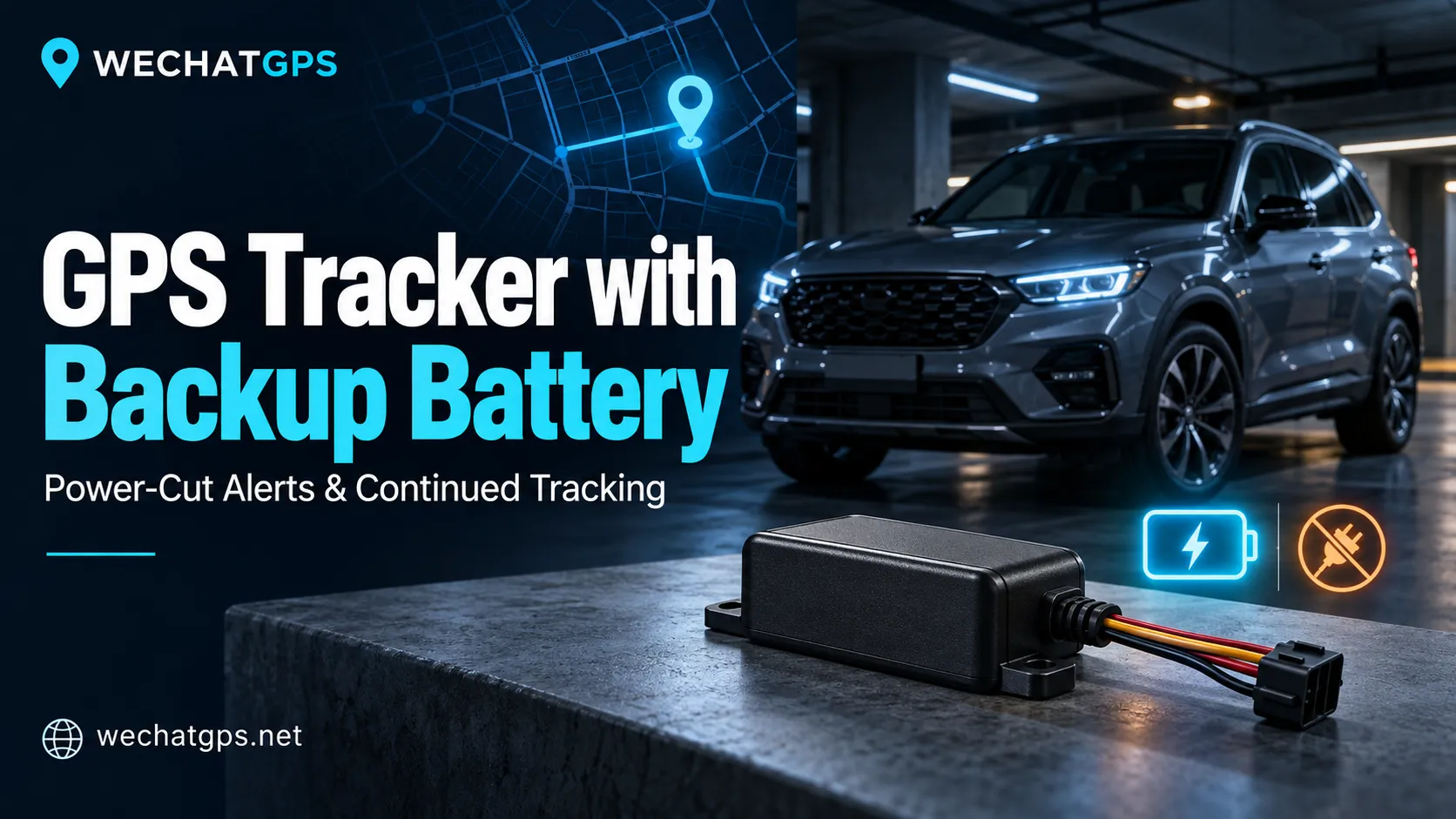
A wired vehicle tracker normally receives power from the vehicle’s electrical system. But what happens when the vehicle battery is disconnected, a cable becomes loose, or the tracker loses its external supply?
A GPS tracker with backup battery can continue operating temporarily after external power is lost. Depending on its hardware and firmware, it can report a power-cut event, send additional locations and help operators understand what happened.
The important purchasing question is more specific than whether a battery is included: what can the device do after a power failure, and for how long under your required reporting conditions?
What Is a GPS Tracker with Backup Battery?
A GPS tracker with backup battery combines a wired power input with an internal rechargeable battery. During normal operation, the external supply powers the tracker and charges the battery according to the device’s charging design.
When the external input disappears, a compatible power-management circuit transfers operation to the internal battery.
For example, the WECHATGPS 4G Wired Vehicle GPS Tracker lists a built-in backup battery and vehicle power-disconnection alerts. Confirm the exact hardware version, supported input voltage and backup operating profile before ordering.
An internal backup battery serves a different purpose from a large battery in a standalone asset tracker. Its capacity may be intended for temporary reporting rather than days of frequent tracking.
What Should Happen After External Power Loss?
A useful power-loss workflow has four stages. These are functions to specify and verify during a pilot; availability depends on the selected configuration.
1. Detect the Power Change
The device monitors its external input and identifies a power-loss condition. Detection thresholds and confirmation delays should be chosen to avoid treating brief voltage disturbances as repeated incidents.
ACC status must be handled separately. Turning the ignition off does not necessarily remove the tracker’s main supply when it is connected to a constant-power circuit.
2. Preserve Operation on Backup Power
The power circuit should keep the tracker running during the transition. A poorly controlled transition can cause a reset before the event is recorded or transmitted.
3. Report the Power-Cut Event
Where cellular coverage is available, the tracker should send the event to the server. Useful event fields include the device ID, event time, external-power status, battery state and location information.
The platform should distinguish the time of the event from the time it received the message. If the location is an earlier valid fix, its original positioning time should remain visible.
4. Follow a Defined Backup Reporting Strategy
After the first alert, firmware may continue frequent reporting, switch to a longer interval or use a movement-triggered strategy. Define this behavior explicitly, including what happens when the backup battery becomes low.
Power-Cut, Offline and Removal Alerts Are Different
These alerts provide different evidence and should have separate labels in the management platform.
| Alert | What it indicates | What it cannot establish by itself |
|---|---|---|
| External power-cut alert | The tracker detected loss of its external supply | Whether the cause was theft, maintenance or a wiring fault |
| Offline alert | The server has not received expected communication within a configured period | Whether the tracker lost power or cellular coverage |
| Removal or tamper alert | A supported sensor or detection mechanism reported a removal-related event | Whether every possible removal method will be detected |
| Low backup-battery alert | The internal battery reached the configured low-level condition | A precise remaining runtime without a validated estimate |
A power-cut event should prompt investigation. It does not automatically prove that someone intentionally disconnected the tracker.
How Long Can the Tracker Run on Its Backup Battery?
There is no universal answer. Runtime depends on usable battery energy and average power consumption in the selected operating mode.
Factors to evaluate include:
- Battery capacity, condition and starting charge.
- GNSS acquisition time and positioning frequency.
- Cellular signal conditions and connection retries.
- Location reporting interval and server acknowledgements.
- Sleep behavior and connected accessories.
- Operating temperature and battery age.
Ask for a measured runtime under a stated test profile. “Several hours of backup” is incomplete unless the supplier specifies reporting frequency, network conditions and the end-of-test criterion.
Measure both total operating time and the number of useful reports successfully received. A device that remains powered but cannot deliver the required information may not meet the project requirement.
Does a Backup Battery Guarantee an Immediate Alert?
No. Backup power can keep the electronics operating, but alarm delivery still needs a working communication path.
If the vehicle is in an underground garage or outside cellular coverage, the tracker may be unable to send the event immediately. Where offline event storage is supported, it should retain the original event time and upload the record after connectivity returns.
During testing, check whether delayed events are clearly identified. A recovered historical alert should not appear to be a new incident occurring at the moment of upload.
A Practical Acceptance Test for Buyers
Use the actual tracker version, firmware, SIM and platform intended for deployment. Begin with a fully charged backup battery and a controlled test setup operated by a qualified installer.
| Test | What to check |
|---|---|
| Normal external power | Device online status, location updates and charging behavior |
| Ignition off with main supply present | ACC changes without an incorrect main-power-loss alarm |
| External supply disconnected | Device remains operational and records the correct event |
| Alarm delivery | Event time, server receipt time and notification receipt time |
| Continued backup operation | Reporting interval and useful reports delivered until the agreed endpoint |
| Temporary network loss | Event retention and recovery, where supported |
| External power restored | Power status recovery, charging and return to normal reporting |
| Repeated power transitions | Duplicate suppression and stable operation |
Agree pass criteria before the pilot. Specify the maximum acceptable notification delay under defined coverage conditions, minimum backup reporting duration and required message fields.
Repeat representative tests under realistic installation and temperature conditions. Results from a new device on a laboratory bench should not be assumed to represent every installed vehicle.
When Is a Separate Battery-Powered Tracker Useful?
An internal battery helps when the wired tracker loses external power. It remains inside the same enclosure, so removing the entire device also removes that tracking hardware from the vehicle.
For projects requiring a second tracking point, evaluate a separate battery-powered device installed elsewhere. This introduces additional device management, charging or replacement work and SIM costs where cellular connectivity is used.
The Vehicle Finance GPS Tracking Solution describes both a main wired terminal and an optional separate backup tracker for higher-risk applications. Device selection should follow the required tracking interval and maintenance plan.
Choosing a Wired GPS Tracker for Your Project
Before purchasing a wired GPS tracker with backup battery, provide the supplier with the deployment country, vehicle type, supported supply voltage, reporting frequency and required post-disconnection runtime.
Also confirm how power-loss events reach operators, who handles them, and whether your own server needs protocol documentation or API integration.
Shenzhen Jinshengchang Technology Co., Ltd. offers custom GPS tracker and IoT device development. Backup power, event reporting and platform integration requirements should be included in the agreed project specification and verified on pilot devices.
Frequently Asked Questions
Can a GPS tracker work after the vehicle battery is disconnected?
Yes, if the tracker has a charged backup battery and supports operation from it. Continued location delivery depends on the battery, positioning conditions, cellular connectivity and firmware settings.
Does switching off the engine trigger a power-cut alarm?
It should not when the tracker retains its constant external supply and correctly distinguishes ACC status from main-power status. Incorrect wiring or configuration can produce unexpected behavior.
Is backup battery capacity enough to compare two trackers?
No. Compare tested runtime and reporting performance under the same conditions. Battery capacity alone does not describe device consumption or alarm delivery.
Can a tracker report a power-cut event without cellular coverage?
It cannot deliver a cellular message without a usable connection. A configuration with offline event storage may retain the event and transmit it once communication returns.
What should I request before a bulk order?
Request the exact model specification, backup-mode description, alarm message format and a pilot test report using your intended reporting profile.