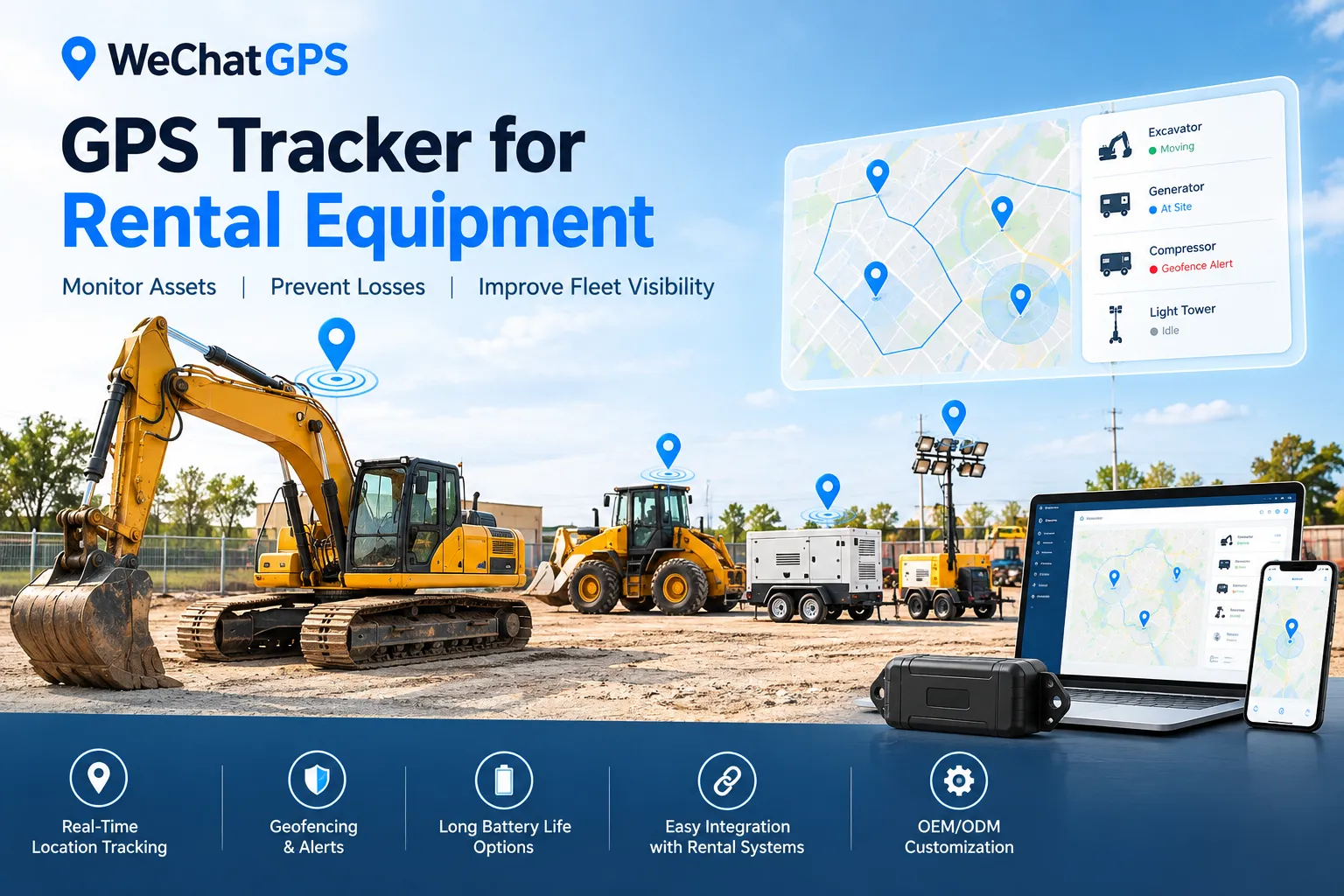
Equipment rental companies face a different tracking challenge from traditional vehicle fleet operators. A rental business may manage excavators, generators, compressors, agricultural machinery, mobile lighting towers and other valuable equipment across multiple customer sites.
These assets are frequently moved, temporarily stored and transferred between locations. Some operate every day, while others remain unused for weeks. Without reliable location information, rental companies may struggle to identify misplaced equipment, investigate unauthorized movements and coordinate collection after a rental period ends.
A GPS tracker for rental equipment helps businesses improve asset visibility by combining location monitoring, movement detection, geofencing and centralized tracking software.
For rental operators, the goal is not simply to see a position on a map. It is to build a practical system for managing equipment throughout its rental lifecycle.
1. Why Equipment Rental Companies Need GPS Tracking
Rental equipment often changes location and users more frequently than permanently installed industrial machinery.
An excavator may move from one construction site to another. A generator may be delivered to a temporary event venue. A trailer-mounted compressor may remain at a remote worksite overnight.
These situations create several operational risks.
Equipment loss and unauthorized relocation
When machinery moves without the rental company's knowledge, staff may need to contact customers, drivers and site managers to determine its location. A GPS tracking device can provide recorded location updates and movement alerts to help investigate unexpected activity.
Delayed equipment collection
After a rental contract expires, knowing the equipment's last reported location can help the operations team plan collection and reduce unnecessary travel.
Limited visibility across multiple sites
Companies with equipment distributed across different cities or regions need a centralized way to review locations instead of maintaining separate manual records.
Inefficient maintenance planning
Location and movement information can help managers understand where equipment is deployed and coordinate inspections, although accurate operating-hour records generally require suitable engine or machine data integration.
2. What Features Should a GPS Tracker for Rental Equipment Have?
Not every GPS device is suitable for industrial rental applications. Product selection should consider installation conditions, expected movement, power availability and the required reporting frequency.
Real-Time and Scheduled Location Reporting
Different assets require different tracking intervals.
A machine being transported between sites may require frequent location updates. Equipment stored in a warehouse may only need periodic reporting and an alert when unexpected movement occurs.
Configurable reporting intervals help balance location visibility, cellular data usage and battery consumption.
For rental companies, the tracking configuration should reflect the equipment's actual usage pattern rather than applying the same reporting schedule to every asset.
Movement Detection and Geofence Alerts
A geofence is a virtual boundary created around a location such as a warehouse, construction site or equipment storage yard.
When supported and properly configured, a tracking system can generate alerts when equipment enters or leaves a designated area.
Movement detection can also help identify activity outside expected working periods. Combined with location history, these functions provide additional information for investigating unauthorized relocation.
Long Battery Life for Unpowered Equipment
Some rental assets have accessible electrical systems, while others remain unpowered for extended periods.
Battery-powered GPS trackers are useful when permanent wiring is impractical. For equipment regularly exposed to daylight, a solar-assisted tracker may be worth evaluating.
Battery life depends on reporting frequency, network conditions, temperature, positioning time and the device's power-management strategy. Buyers should request performance estimates based on a clearly defined operating profile.
Rugged Housing and Flexible Installation
Construction equipment and outdoor machinery may encounter dust, vibration, rain and significant temperature changes.
Before selecting a tracker, confirm its tested ingress protection rating, operating temperature range, mounting method and suitability for the intended installation location.
A magnetic tracker may simplify installation on compatible metal surfaces. Other equipment may require brackets, screws or a protected internal installation.
3. Choosing Between Wired, Battery-Powered and Solar GPS Trackers
The best device depends on how the equipment is powered and used.
Wired GPS trackers
Wired devices are worth considering when the machine provides a suitable power supply and the installation can be completed safely. They can support continuous monitoring without relying entirely on an internal battery.
Battery-powered GPS trackers
Battery-powered models suit trailers, portable generators and other assets where permanent wiring is undesirable. Low-power operation and movement-triggered reporting can help extend service intervals.
Solar-assisted GPS trackers
Solar-assisted devices can be useful for outdoor equipment with sufficient sunlight exposure. They may reduce the frequency of manual charging, although actual performance depends on installation, sunlight, reporting frequency and energy consumption.
For companies managing several asset categories, a mixed-device strategy may be more practical than deploying one tracker model across the entire fleet.
4. How GPS Tracking Supports Rental Equipment Recovery
Equipment recovery is one of the most commercially important applications of location monitoring.
A typical workflow includes four steps.
Step 1: Register the equipment
Assign each tracker to an equipment record containing the asset identifier, model, customer, rental agreement and expected return date.
Step 2: Define the expected operating area
Create geofences around authorized sites or storage locations where appropriate.
Step 3: Monitor movement and location history
Review reported positions and alerts when an asset moves unexpectedly or requires collection.
Step 4: Coordinate recovery
Use the latest available location information to help the operations team investigate and arrange collection.
GPS tracking is not a guarantee of recovery. Location accuracy, cellular coverage, power status, installation and physical interference can all affect the information available to the operator.
For assets transported through areas without cellular coverage, alternative connectivity or satellite communication may need to be considered.
5. GPS Tracker Integration with Rental Management Software
A tracking device becomes more useful when its data can be incorporated into existing business systems.
A rental management platform may already store contract dates, customer details, equipment availability, maintenance schedules and delivery records.
With an appropriate API or server integration, GPS data can complement these records and help staff answer practical questions:
- Where was the equipment last reported?
- Has it moved outside its designated area?
- Which assets are currently at a particular jobsite?
- Which devices have low battery levels or have stopped reporting?
- Which assets may require investigation before collection?
Integration requirements should be defined before deployment. Confirm device identifiers, message formats, update intervals, alert events, API permissions and the expected behavior during network outages.
For larger fleets, pilot testing can help identify integration issues before the tracking system is rolled out across the entire rental inventory.
6. How to Estimate the Cost of a Rental Equipment Tracking System
The purchase price of the tracker is only one part of the total cost.
Rental companies should also evaluate:
- Hardware cost per asset.
- SIM cards and cellular data charges.
- Tracking platform or server costs.
- Installation and commissioning.
- Battery replacement or charging requirements.
- API integration and ongoing technical support.
A useful comparison is the annual cost per tracked asset.
For example, if a tracker and its associated services cost a total of $120 per year, and improved asset control prevents $600 in annual losses or avoidable operational expenses, the potential net benefit is $480 per asset before other implementation costs.
These figures are illustrative only. Actual returns depend on the equipment value, loss rate, rental utilization and operating expenses.
The most effective evaluation compares the complete tracking cost with measurable improvements in asset recovery, staff efficiency and equipment availability.
7. Custom GPS Tracking Hardware for Equipment Rental Businesses
Rental companies and telematics solution providers may have requirements that standard off-the-shelf products cannot fully address.
Shenzhen Jinshengchang Technology Co., Ltd. develops GPS tracking hardware and IoT solutions for industrial and commercial applications. Depending on the project, customers can evaluate battery-powered asset trackers, solar-assisted devices, wired GPS trackers and customized tracking systems.
Relevant solutions include:
- Solar Asset GPS Tracker for Outdoor Equipment for evaluating solar-assisted monitoring of suitable outdoor assets.
- Shipping Container GPS Tracker for related container, trailer and logistics tracking applications.
- OEM/ODM Custom Development for projects requiring hardware adaptation, firmware development, platform integration or customized branding.
Available configurations depend on the selected product and project requirements.
Before requesting a quotation, rental operators should prepare the equipment types, deployment countries, estimated device quantity, power requirements, expected reporting intervals and preferred tracking platform.
This information helps determine whether an existing device is suitable or whether a customized solution is necessary.
8. A Practical Checklist Before Deploying GPS Trackers
Before purchasing devices for a rental fleet, confirm the following points:
- Asset compatibility: Identify which equipment types need tracking and how each device will be installed.
- Power strategy: Decide between wired, battery-powered and solar-assisted options.
- Connectivity: Verify cellular band compatibility and coverage in the deployment region.
- Tracking requirements: Define reporting intervals, movement detection and geofence behavior.
- Platform integration: Confirm whether the business will use an existing platform, a supplier platform or a private server.
- Field testing: Test representative assets under actual operating conditions before ordering at scale.
- Commercial evaluation: Compare hardware, connectivity, installation and software costs against expected operational benefits.
For multi-country deployments, regional network compatibility and local regulatory requirements should be reviewed before production and shipment.
Conclusion
A GPS tracker for rental equipment can help rental businesses improve location visibility, investigate unexpected movement and coordinate equipment collection more efficiently.
The right solution depends on asset type, power availability, reporting requirements, connectivity and software integration. Battery-powered, wired and solar-assisted trackers each serve different operational needs.
For rental companies, equipment manufacturers and telematics providers, the best starting point is to define the use case, test the selected hardware and validate the complete tracking workflow before scaling deployment.
Looking for a GPS tracking solution for rental equipment? Contact WeChatGPS to discuss asset tracking hardware, OEM/ODM customization, firmware requirements and platform integration for your project.